As part of recent Louisiana State Poet Laureate, Alison Pelegrin’s Lifelines Poetry Project and in partnership with the New Orleans Poetry Festival, Louisiana State Penitentiary—commonly known as Angola—opens its gates to poetry in an unprecedented event of artistic expression and solidarity. This landmark performance brings together renowned poets to transform a space long defined by confinement into one of creativity and shared humanity. This represents a bold step forward in recognizing the role of art in healing, rehabilitation, and social change. By bringing poetry into Angola, the event challenges boundaries—both literal and figurative—offering a glimpse of freedom through language and imagination. This program is made possible by the generous support of Louisiana State University's MFA Program.
Complete schedule of events with description, time, venue, and participants.
To search for names or other key terms, use your browser's search function (Command or Ctrl F, or menu on mobile).
Events will cycle off this schedule three hours after their start times.
Louisiana State Penitentiary, 17544 Tunica Trace, Angola, LA 70712
The New Orleans Poetry Festival takes the show on the road to Thibodaux in 2026. In partnership with Nicholls State University, this bilingual Spanish/English event features Mexican performers Lucia Hinojosa Gaxiola and Román Luján, along with Louisiana poets, Christopher Monier, Rachel Zavecz, & Rodrigo Toscano. After a performance of their work, these poets will hold a brief Q&A. Free and open to the public, this event will take place on Wednesday, April 15th, 1PM in Le Bijou Theater in the Donald G. Bollinger Memorial Student Union, 104 Ellendale Dr., Nicholls State University, Thibodaux, LA 70301.
Le Bijou Theater in the Donald G. Bollinger Memorial Student Union, 104 Ellendale Dr., Nicholls State University, Thibodaux, LA 70301
What a poetic privilege it’s been to put on The Splice Poetry Series which has spanned 5 calendar years in a city well-touted for its art-mindedness. And no bigger honor that from the ashes of our electrical fire on April 16 will begin this year’s New Orleans Poetry Festival (you know the one 😉). Over half of the poets who have read for Splice over the years will convene @thesaturnbar for NOPF opening night, performing a single poem each. One last zip-zap for the masses!!! ⚡️💥
Our utmost gratitude to @saltedteeth for offering this gorgeous design to commemorate the close-out. Limited lagniappe of this design will be given away as bookmarks the night of!! Thank you, Christopher!!
Saturn Bar
"Theresa, I Miss You" is a durational installation/performance piece, in which Mia Kang will roam the spaces of New Orleans Poetry Festival "as" Theresa Hak Kyung Cha, the Korean Amerian conceptual artist and writer best known for her book Dictée. This movement-based performance is part of an evolving body of work, initiated in 2015, that thinks alongside and after Cha, whose
ouevre spans concrete poetry, film and video, performance, and visual art. As a series, "Theresa, I Miss You" moves between embodied practice, objects, and text within specific institutional and architectural contexts. Stairwells, plazas, classrooms, galleries,
hallways––these become sites of study and gates for alternate states within and around the artist. In New Orleans, where Kang's personal history brings a weight of grief and memory to bear, this performance offers a small presence for Cha, a haunting that is alive and a question about love. Kang will be present and working in multiple spaces throughout the days of the festival. Find this
piece where it finds you.
All (Mobile)
Expressing the desire and need for a poetics that has a political horizon beyond that of the lyric as mere song of the individualized bourgeois subjectivity, Anne Waldman writes: "Documentary is our new hope. / We will fill the ranks." This roundtable will feature poets discussing the theoretical and practical aspects of working in archival and documentary modes. These four poets will offer artist-talks then hold space for an open discussion testifying to the potentials of documentary poetry as well as testing the limits of archival poetics. The artist-talks will cover a range of poetic media and genres including digital video, photography, and writing as a technology for reckoning real life.
The roundtable will cover approaches to documentary that are influenced by historiography and activist journalism as well as approaches to familial archives, and archives of the state; these poets will cover themes and dynamics implicit in documentary and research-based lyric practices such as: the archives generated from asylum hearings within contemporary migration and US-Mexico border politics; the bureaucratic archive justifying the so-called Global War on Terror (and its activist counter-archive); the Palestinian diaspora as manifest in a family archive; and how the "documentary motive" can alloy lyric practice.
Café Istanbul
Small Press Fair (10:00 AM – 5:00 PM): Browse and buy from dozens of independent publishers, zines, and literary journals in the Grand Hall of the New Orleans Healing Center. Meet the makers, discover new poets, and support independent publishing culture.
Grand Hall, New Orleans Healing Center, 2372 St Claude Ave
Join us for a book making ritual in which we construct book-bodies to accompany us into a post apocalyptic future. Drawing on memory, found objects, ancestral knowledge, plant medicine, secrets, weather systems, and the recursive wisdom of death, we will play with the book form as object and subject, as kin. Whether a survival guide or an intimate memory archive, these books-as-bodies can deepen our understanding of this time of collapse and its potential future by exploring how the book can be a bridge to an alternate body future—expanded, entangled, folded, stitched.
here now: in which Sargon [Sargon Boulus] speaks of “being at the threshold of a mysterious [uncertain] world, still unexplored and residing in the depth of linguistic memory.” -- Ammiel Alcalay, Controlled Demolition
Kolaj Institute, 2374 St Claude Ave #230
This roundtable offers a rigorous investigation into the complex relationship between fidelity and creativity in contemporary translation, exploring the transformative process between languages, media, and materiality as the site of profound philosophical inquiry. How does political history reverberate through the rift opened by the distance of translation? What is this distance composed of? Is it present in other language acts, or in the construction of meaning generally? What transformations can be called translation, and how does stretching this definition inform each mode? Where is the boundary between assimilation and the political right to opacity? This panel explores these subjects in depth while examining the art of translation through lived examples.
There are many paths towards fidelity, if fidelity to a singular, stable original is even a worthy aim. A straightforward conveyance of meaning and sentiment is equally as valid as forging non-hierarchical, rhizomatic connections across disparate territories. In fact, the two are not mutually exclusive. Consider the materiality of our oldest preserved narratives: a cuneiform tablet needs light and shadow to be read. It can hold water in the wells of its marks. There have even been instances of students biting the clay out of boredom, thus sending an impression of their teeth down through the centuries. How can a translation capture this embodied, material trace? This question extends beyond the archaic. One panelist uses distance from a sensor in a painting to produce music, redefining the text as a new sensory machine and an assemblage of physical and digital inputs. The question of fidelity also appears in practices of deliberate mistranslation or self-translation, which use constraint to deconstruct the original and expose its hidden political ideologies. And it becomes a vital act of resistance when a translator, working from a geopolitical conflict zone, deliberately foreignizes the target language, refusing to assimilate a politically-charged text fluently and instead imbuing it with discomfort to mark the violence of its origin.
This panel journeys from the physical materials of language—clay, code, paper, or soundwave—to the political praxis of the translator. It explores translation not as a simple transfer but as a site of constant negotiation: a dynamic field of exchange, political pressure, generative slippage, and even productive betrayal. Moving beyond fidelity, the discussion will posit translation as a minoritarian mode: a deterritorializing machine that makes a major language stutter, infecting it with the foreign. By examining translation as a deconstruction of the original, an embodied encounter with otherness, and a method for curating a “minor archive,” this roundtable reframes the act. It is not a secondary craft, but a primary and urgent philosophical praxis for our time.
NOHC 204
Ekphrasis is usually defined as poetry written in response to art. This roundtable radically expands the practice, revealing its potential to bring action, activism, self-revelation, and vision into our writing. Five poets working with performance, sound, film, visual art, and installation will discuss innovative approaches to ekphrasis. Mary Burger will discuss metanarrative and figurative poetic language as tools for creating a genre-expansive portrayal of a fictional visual artist’s liminal self-awareness. Kristina Kay Robinson will present on her use of audiopoetics in her performance project, Republica: Temple Of Color and Sound. Sarah Rosenthal will discuss how working in poetry, dance, and film allows ideas and practices used in each art form to influence and productively “pollute” work in the other two forms. Christina Vega-Westhoff will talk about how ecosomatic poems and choreographic research can both speak to the topic of remediation in the Eastern Great Lakes region. Presentations will include excerpts from the creative work discussed. Our hope is that attendees will leave with fresh insights into how working intermedially can generate fresh approaches to language and enliven creative practice.
NOHC 250
In this moment when history is being rewritten and erased, writers must rely on practices that give them the freedom to chronicle daily life honestly and urgently. Confessional serial writing such as diary, cronicas, essays, notes, fragments, and letters, opens up an important path towards not only the cultivation of personal and historical archives, but also longer creative projects. Five BIPOC, LGBTQIA+ multi-genre writers discuss the ways confessional serial writing transforms the writing process, and allows for a sense of exploration, experimentation, challenge, lyricism, and query with the untethered Self.
NOHC 300A
Panelists will discuss various aspects of leading writing workshops with incarcerated individuals, including the logistics and challenges of establishing and maintaining these programs. The panelists will also discuss funding and supporting these vital programs even when prison administrations might not value their importance. Finally, the contributors will share successful workshop prompts and offer advice to attendees interested in pursuing similar opportunities in their local communities.
Café Istanbul
PostFest Note: View results of this workshop at https://geodes.scripter.net/taste/new-orleans-poetry-swim.
Leap from page to screen and turn your words into beautiful, flowing images of language.
Share your poem online and go viral, or just keep it to yourself and your intimates.
This generative workshop will follow in the non-tradition of the Situationists and psychogeographers with a prompt reflecting on and animating the urban milieu. After locating our impulse, we will create live animated poetry tied to the immediate environment — to echo Baudelaire, where the world is a forest of symbols — using a locative web app, Geodes.
A workshop for those who are curious about the possibilities of digital work, and poets ready to explore alternative and multi-modal formats using the best distribution network of all time, the internet. You will have an opportunity to play with the elements of animation — timelines, pauses, font & color, FOV (field of view), viewer constraints, scrolling, and more — and to share with your social media feeds, on your websites, or across your digital communities.
Geodes is a free hybrid poetry + code web app that focuses your intent on what's 'here' and not 'there.' We locate our inspiration in the immediate environment using Geodes as an original space that removes political boundaries, for undifferentiating reflection, play, and personalization. The individual animates their city and leaves an historical trace.
Available to any poet with a phone, laptop or tablet, and for those inclined to dip into alternatives to the printed page, and multi-modal formats with text, image and audio. Bring your poems, pics and audio clips, or create them on the spot. All poems will remain after the festival for your sharing or private pleasure.
We may also create a New Orleans Poetry Festival 2026 collection if interests collide.
A few examples:
A timed text - https://geodes.scripter.net/stroke/roman-morning
A scrolling text - https://geodes.scripter.net/stroke/as-you-are
A click-through text - https://geodes.scripter.net/stroke/the-stand
Kolaj Institute, 2374 St Claude Ave #230
To be is to sing the aesthetic poison of colonial historicity. For poets whose families and histories emerge from the lands sometimes called Mesoamerica, there is always a question of relation and separation. How to relate to the archives of Mesoamerica from which so many have been forcibly separated and alienated? How to bring the archives of the archaic into contemporary poetics? And, furthermore, how to do so by reckoning with (and not ignoring) the colonial systems by which such histories find their way into our hands? In this panel we will nucleate this conversation around five poets whose recent books, in their own ways, seek to think with the aesthetic forms of hard histories and their complex contemporary reception: Steven Alvarez’s Tonalamatl (Calamari Archive, 2024) ; Paul Martinez-Pompa’s Domestic Corpse (Match Factory Editions, 2025); Jose-Luis Moctezuma’s Black Box Syndrome (Omnidawn, 2023); Geronimo Sarmiento Cruz’s whalefall (Rescue Press, 2026); and Edgar Garcia’s Cantares (Wesleyan UP, 2026). Focusing our conversation will be the idea of song—cantar—as a nexus of voice, loss, breath, life, risk, and recursive articulation.
NOHC 204
In this roundtable event, panelists will discuss the rendering of purity culture in the Southern Gothic style. The American South has a complicated relationship with women’s bodies as the centers of desire and fear, a theme that often appears in Southern Gothic poetry—and a theme that contemporary women poets twist and unravel to display the underbelly of what it means to define women in terms of abjection, repulsion, and distortion. Poets raised in the multifarious purity cultures of the South wrestle with claiming and queering their sexualities through lenses of race, gender, and class. The poets in this panel will consider questions such as: What does it look like to broach socially transgressive sexualities, such as queer desire, kink, polyamory, or infidelity in our poetry? How can we navigate the subject of spirituality when organized religion has been a sexually repressive, fraught space? How can the Southern Gothic style be an advantage towards exploring these themes? The moderator will provide a critical introduction to the Southern Gothic and thinking surrounding purity culture/s before panelists contextualize their work within the genre and read a selection of poetry. An audience Q&A will follow.
NOHC 250
How can poetry become a radical call to action in a world facing down the Anthropocene and climate change? This panel explores how language can create transformative and radical acts of subversion, reveal the physicality and form of our commodification of nature, and wander into a speculative future that embraces collective witness. With Jake Syersak’s eco-Surrealism and translation of revolutionary poets, Laura Paul’s dissection of illusory aspects of transforming raw materials into creative works, Paul Cunningham’s sociocidal and hallucinatory explorations of internet culture, gallery culture, and the meat-packing industry, and Josh Fomon’s incantatory wanderings through a future world ravished by climate change and destruction, these poets will discuss what it means to envision radical change in our world.
NOHC 300A
In this session, four poets for whom a writing language isn't a native language, but a second, third, or fourth language, will read from their most recent manuscripts-in-progress. These poems, though primarily in English, work with other languages through multilingual poetics and self-translation. For three poets in this reading, the self is brought into English by way of German, Spanish, and Persian, but for one poet, Creole comes into focus, so as to assert itself over the native tongue. Before the reading, each poet will take a few minutes to talk about their writing processes, which, we hope gives the audience an understanding of how one's other language(s) inform and determine one's form, voice, and diction.
AllWays Back
Common Place Poetics is delighted to propose a reading featuring poets who have contributed to our intimate journal. Common Place is a seasonal publication of poetry and poetics, co-edited by Samira Abed, Scout Turkel, and Hannah Piette. Founded in 2024, we have published five “seasons” of poetry and poetic prose: https://commonplacepoetics.com. This coming spring, we will celebrate two years of Common Place. Our journal asks, how is poetry a method for living, and how is living a method for poetry? We maintain that poetry turns both toward and against everyday life for its materials. Common Place gathers writing which engages this dialectical condition.
Our participating writers will read from poems that speak to these questions. Of special importance to our journal is “conversation." Poetry allows and necessitates lively correspondence. The poets who have so far contributed to Common Place have entered into conversation with one another through their writing — this reading and gathering will concretize that exchange.
AllWays Front
This roundtable gathers five artists whose work enacts visionary practice not as transcendence but as deep listening—to language, to the past, to archaeological time, to presences human and otherwise that dominant culture has rendered inaudible. Rather than discussing vision as abstraction, these practitioners embody five distinct frequencies of listening: Lee Ann Brown's syntactical ruptures create apertures in language itself; Lucía Hinojosa Gaxiola conducts an auditory archaeology that translates material traces into sonic and visual scores; Gabrielle Octavia Rucker dissolves ego boundaries through ecstatic attunement; Alicia Wright practices ethical witnessing to restore visibility to suppressed histories; and Tanner Menard integrates contemplative embodiment with phenomenological hermeneutics. Seated together in New Orleans—a city of layered temporalities, suppressed presences, and ongoing labor of witnessing erasure—these five will read, speak, and listen from the place where poetry becomes a technology of relation: not representation, but actual attunement to what exceeds language. The roundtable itself functions as a ceremony of resonance, where the act of collective listening enacts the very relationality these artists theorize through their distinct practices.
Each artist demonstrates a different frequency of visionary listening. Brown's work attunes us to the rupture within language itself—the moment when syntax breaks and new kinship becomes possible. Hinojosa Gaxiola's auditory archaeology invites us to listen across time—to hear in archaeological shards, in old photographs, in wind's abrasion against stone, a voice that has been waiting generations to be heard. Rucker's ecstatic practice teaches us to listen with a body that has dissolved its boundaries, becoming a vessel through which numinous presences speak. Wright's occult hermeneutics teaches us to listen for what has been deliberately silenced—to hear the ghosts, the erasures, the testimonies that power tried to bury. Menard's integration of yoga and phenomenology demonstrates that listening requires sustained embodied practice—that to perceive truly, the whole organism must be retuned. These are not separate approaches but interlocking frequencies. The frictions between them—between linguistic rupture and sonic attunement, between archaeological time and ecstatic dissolution, between ethical witnessing and phenomenological rigor—generate the conditions for new listening to emerge. New Orleans itself becomes a fifth collaborator: a city that demands we listen to what colonialism, slavery, and modernization tried to silence, and to sit in the company of all those presences.
An Invitation to Audiences
This roundtable calls to those who understand that poetry is not entertainment but survival practice—to experimental poets working outside academia, to residents of New Orleans' vital reading communities (Blood Jet, Dogfish, Normie Creep, The Splice), to meditators and yoga practitioners who recognize that contemplative work transforms not just consciousness but language itself, to those who practice occult arts or work with sound and sonic materials, to anyone who has felt called to listen more deeply to what has been made inaudible. This gathering is for people who sense that vision and hearing are inseparable—that to see truly is to listen, and that collective listening is a form of healing, of reparation, of bringing what has been fractured back into wholeness. Come to experience five distinct modalities of visionary practice interlocking in real time, to feel the resonances and frictions between them, and to discover what new frequencies of listening can emerge when artists committed to relationality sit together and create conditions for presence—your presence, your listening, your capacity to be moved by what exceeds words.
Café Istanbul
The Louisiana French word lagniappe means “a little something extra.” In New Orleans, lagniappe is a gesture of generosity—a small bonus given freely, whether an extra shucked oyster, a long pour, or an unexpected kindness from a neighbor. This spirit of abundance and reciprocity resonates where poetry is not just a genre but a living practice embedded in community, resistance, and cultural exchange. These Lagniappe Readings celebrate this ethos, offering a space where six poets perform their work.
Kajun's Karaoke Bar, 2256 St Claude Ave
Hybrid Kinships: Writing Across Disciplines and Senses
In literary culture, authorship is often framed as an individual achievement rather than a collective ambition. In doing so, a solitary writing practice almost seems like a necessity rather than a choice. What would it mean, instead, to approach writing as an ongoing conversation with others, on and off the page? Hybrid kinships stem from a desire to tap into creative writing's potential for radical community-making. How might writers develop a creative practice that prioritizes belonging rather than separation? How might writers develop, as the scholar Alex Brostoff writes, "queer mode[s] of belonging that contests the conceit of a single self"?
Drawing upon our own experiences with hybrid writing, we will guide participants through the practice of developing hybrid kinships in their work. We will also look at examples of hybrid kinships from poets such as Lyn Hejinian, NourbeSe Philips, and John Murrillo. Using intertextual and intersensory writing activities, the workshop will explore ways of writing with-and-for others, offering participants the opportunity to generate new work that cuts across disciplines and senses.
Kolaj Institute, 2374 St Claude Ave #230
Building on an original concept by poet and anthropologist Yuyi Chen, and inspired by the writings of Sylvia Jones and Cait O’Kane, this panel explores the urban influence of cities within New York State, as well as more widely in each poet’s life, upon the poetry of Joe Hall, Thom Eichelberger-Young, and Ry Cook. The hope is to produce a potential template for wider incorporation of urban attention within poetic practice, no matter the geographical realm of domicile, though we simultaneously acknowledge the limitations in scope are by no means comprehensive or universal. The roundtable features readings and explorations of each poet’s recently published works (from Cloak, Black Ocean, and Choo Choo) from a craft oriented perspective (with attention to the many poets attending the festival), attuned to their lives in Buffalo and New York City, as well as an introductory “surrogate” invocation of Chen and O’Kane conducted by the panelists.
NOHC 204
One defining characteristic of the ecstatic is what scholar D.J. Moores calls “radical self-transcendence”: a desire for which has frequently called readers to poetry, even across distinct literary traditions. Yet, despite ecstasy being a traditional poetic subject, poets today are still finding ways to renew this rupture of—and also beyond—self. In this reading, five emerging poets—Darius Atefat-Peckham, Gauri Awashti, Isabella DeSendi, Sebastián H. Páramo, and Phil SaintDenisSanchez—will dive into the role of ecstasy in their writing. Drawing upon both the modern and etymological definitions of ecstasy—the latter being "ex-" out of and "-stasis" immobility—these poets inhabit ecstasy through their respective cultural heritages in deeply personal but refreshingly novel forms.
Darius Atefat-Peckham will read from Book of Kin (Autumn House Books, 2024), a hauntological chronicle of living through grief, and also a formal assemblage finding relation between Sufi mysticism and deep gratitude in the joy of ordinary experience. Gauri Awasthi will read from The Mother Wound (forthcoming Trio House Press, 2026) a collection which memorializes the generational trauma of women through the rhythm of Indian classical music, and whose subtle manipulations of time recall the dreamy logic of film montage. Isabella DeSendi will read from Someone Else’s Hunger (Four Way Books, 2025), a powerful, transmutative work that seeks and its earn its moments of bliss; poetic crescendos that often begin as whispers before blooming into full song and dance—pulled from both deeply personal experiences and the recesses of ancestral and familial stories and hardships. Sebastián H. Páramo will read from Portrait of Us Burning (Curbstone Books, 2023), a kaleidoscopic lens capturing a working-class Mexican-American family in Texas through profoundly uttered and thoroughly embodied melodies of a troubled but deeply loved lineage. Phil SaintDenisSanchez will read from before & after our bodies (Button Poetry, 2025), illuminating the essential joys woven into growing up in New Orleans and the celebrations invoked by his ancestral connections and paths tracing back to the earliest Creole communities in Louisiana.
These writers seek to score the trajectory of release and cadential resolution in poetry that becomes all the more vital in the context of contemporary alienation and the imperialist machinery that subsumes so much of the joie de vivre embedded in organic culture. Tawanda Mulalu, author of Please make pretty, I don’t want to die (Princeton University Press, 2022), will introduce the poets and then moderate a brief Q&A to conclude the reading.
NOHC 250
It is particularly important in the current economic context—the broad defunding of arts, the hardships that are the byproduct of devalued artistic endeavors, among other pressures—to consider how the poem is both a vessel and a product of capitalism, and how poetry can explicitly push back against the broad economic system that dehumanizes and, as Adrienne Rich put it, “eviscerate[s] language of meaning.” Five poets will read from work that engages with questions of capital and undertakes the work of rehumanizing and reclaiming meaning.
NOHC 300A
This year's open mic brings two and a half hours of poetic firepower from New Orleans, across the nation, and around the globe. Join MC Lisa Pasold for this can't-miss showcase of voices. All slots are first come, first served—so show up ready with your best work and claim your spot at the mic!
Siberia, 2227 St Claude Ave
This reading features an extensive list of some of our most recognized translator-poets reading poetry in English translation from shithole countries—those named and unnamed. It serves as a way to resist the imperialist, racist, sexist, and anti-LGBTQ+ ideologies which divide us and to recognize how English language poetry in translation plays a prominent role in making works of poetry available and creates international networks for political and social solidarity and change. A partial list of readers is included below. Confirmed participating presses: Action Books, Cardboard House Press, Carrion Bloom Books, co-im-press, Diálogo Books, Eulalia Books, World Poetry Books.
St Roch Tavern
With these contemporary poets' array of approaches, this reading is a visitation of memory amongst the surreal and near. In honor of T.S. Eliot's famous opening lines of The Waste Land, each poet will read poems exploring the complexities of consciousness in being.
AllWays Back
Established in 2023, Working Girls Press uplifts and publishes art and writing by sex workers, a community historically underrepresented and misrepresented in the traditional publishing landscape. This reading from contributors will feature selections from recent and upcoming releases, including The Holy Hour: An Anthology on Sex Work, Magic, and the Divine as well as I Hate My Job: Thots on Sex Work, Labor, and Capitalism.
AllWays Front
The náhuatl phrase for red and black ink signifies the power and permanence of the written word, of poetry. In this video, made expressly for this year’s NOPF by Cannonball Statman, four poets from the state of Oaxaca, read their poems written in Spanish, Zapotec, and English The work reflects on transcendence and language, the influence of landscape, and of immanence and cultural border crossing. The video will be introduced by poet Rodger Kamenetz who will then follow the video leading a short Q and A.
Café Istanbul, 2372 St Claude Ave
The Louisiana French word lagniappe means “a little something extra.” In New Orleans, lagniappe is a gesture of generosity—a small bonus given freely, whether an extra shucked oyster, a long pour, or an unexpected kindness from a neighbor. This spirit of abundance and reciprocity resonates where poetry is not just a genre but a living practice embedded in community, resistance, and cultural exchange. These Lagniappe Readings celebrate this ethos, offering a space where six poets perform their work.
Kajun's Karaoke Bar, 2256 St Claude Ave
YŌL(I) is the náhuatl word meaning to live; to come to life, to hatch. This workshop aims to create an intimate exploration of our “Mother Tongues,” and to question how we trace back our ancestry to language. What sounds were we born with? How has language shifted in the last 100 years? And how does this shift inform our poetic sensibility?
Through the exploration of these questions, etymologies of words, sounds and meditations, aided by the use of breath work, poetry experiments, rituals, and films, we will explore a resurgence of creativity and life force to rethink where language can come from.
We will read fragments of Lizette’s new book POEMAS ANTES DE NACER published by diSONARE, and those texts which influenced Lizette’s work, such as Dictee by Theresa Hak Kyung Cha, as well as listening to interviews and conversations with Mixe Linguist Yásnaya Elena Aguilar Gil, and reading essays by Yoko Tawada.
This workshop invites all mediums, forms, and practices to come together. By creating an intentional space with meaning, we will also look at how books inform language and serve as a form of documentation of Mother Tongues. This workshop is intended to become a collaborative effort inviting all participants to share their work and ideas.
What is the potential to be reborn through language?
Diana Lizette Rodriguez is an experimental artist, poet, and filmmaker. Rodriguez is a graduate from Naropa University, studying at the Jack Kerouac School of Disembodied Poetics, and Visual Arts department. Her work has been published in Womanly Magazine, Asymptote, Unstamatic, the Hong Kong Review, and others. Her films have been screened in Mexico City, San Francisco, and the Performance Space in New York City. Her book Poemas Antes de Nacer is forthcoming with diSONARE editorial. She is the founder of Calle Soledad Presa, an experimental rasquache press.
Kolaj Institute, 2374 St Claude Ave #230
In a time of overwhelming language extinction, as histories are rewritten by the powerful, as war and resource extraction threaten both lives and legacies, literary translation is an act of both defense and resistance. This roundtable brings together two co-editors and two contributors to the 2026 edition of the Best Literary Translations series for a discussion and reading of poetry in translation. (Best Literary Translations 2026, the third edition in the annual series, was guest edited by U.S. Poet Laureate Arthur Sze and will be published the week of the New Orleans Poetry Festival.) All four panel participants translate poetry from languages that have been minoritized: Braj Bhasha, Yoruba, and several lenguas originarias (First Nations languages) in Latin America. Panelists will discuss how poetry in translation from less frequently translated languages pushes back against the xenophobia and racism so prevalent in the U.S. today.
NOHC 204
Queer poets connected to the South and to the Midwest prairie host a roundtable reading of their ecopoetic work, drawing on the storied history of queer and trans naturalist poets. From asexual and transgender plant species, to cruising spots, from the way fire opens seedpods to the way desire opens us to landscape—these poets trace how queerness and the land teach each other. What blooms in the margins? What thrives through transformation? How do our bodies learn from prairie persistence, from wetland regeneration, from species that refuse singular forms? Rooted in specific Southern and prairie ecosystems yet reaching toward broader networks of queer and trans ecological kinship, this reading celebrates attention that won't look away: the erotic life of rivers, the political dimensions of restoration, the futures we're composting together. Come hear poems that know the land as lover, teacher, co-conspirator in making worlds where we all might flourish.
NOHC 250
Poets often are operating in modes influenced by the visual arts and the ekphrastic mode is one example of a popular medium. However, poets also create visual art. Consider Derek Walcott, a painter, and his collection, Tiepolo’s Hound, and how the poet engages with Pissarro impressionist visual observations in his own work. This is abundant in contemporary poetry. We bring together several different poets who work in visual art modes of projection mapping, hybrid, and other forms to discuss how poets who also work in visual art are defining and expanding their work. Some other examples we will reference are Avery R. Young, which features black gospel speech acts as visual, Douglas Kearney, in which the language itself is used as material, as well as the work of Renee Gladman. Other artist-poets who have two distinct practices include Etel Adnan and her paintings—while we also reflect on how Adnan integrates drawn glyphs in works like Arab Apocalypse.
NOHC 300A
New this year: the Small Press Fair Happy Hour (Friday, 4:00–5:00 PM) in the Grand Hall. Nothing else will be happening during that time, so everybody’s invited to hang out, sip a drink, snack, and mix it up with poets and publishers. ~~Buy a book. Drink for free.~~ ; )
Grand Hall, New Orleans Healing Center, 2372 St Claude Ave
Join us for an evening of poetry that spans the experimental, the political, the sonic, and the deeply personal: a celebration of Mexico's dynamic literary present featuring four extraordinary voices from Mexico alongside two exceptional translators based in New Orleans and Mexico City.
Lucía Hinojosa Gaxiola creates experimental poetry that fuses language with performance, sound, film, drawing, and installation. Her recent work includes The Telaraña Circuit (Tender Buttons, 2023), Templos en erupción (2025), and her debut album REZO (Insect Poem)—an ode to the stridulation of insects. Co-editor of diSONARE, an experimental editorial platform from Mexico City, Hinojosa Gaxiola has performed and exhibited at venues from Fonoteca Nacional to The Poetry Project.
Hugo García Manríquez, poet, translator, and scholar with a PhD from UC Berkeley, explores language and political economy in works like A-H. A Reading of NAFTA and Lo Común. As a translator, he has brought essential works by William Carlos Williams, George Oppen, Jack Spicer, and Sean Bonney into Spanish. García Manríquez will be translated by Cameron Lovejoy, New Orleans-based poet, editor, and book artist who operates the micro-press Tilted House.
Karen Villeda, award-winning author of seven poetry collections, three essay collections, and three children's books, brings her genre-defying work that explores the intersections of literature and multimedia through her project POETronicA. Her most recent collection, Teoría de cuerdas (String Theory), has garnered international acclaim, and her work appears in the Library of Congress Archive of Hispanic Literature on Tape—a rare honor for Mexican poets. Villeda will be translated by Whitney DeVos, founding member of NAFTA (the North American Free Translation Agreement) and scholar of Indigenous languages, whose translations have appeared in The New Yorker, POETRY, and Best Literary Translations 2026.
Román Luján, poet, scholar, and translator based in the Bay Area, explores a poetics of anti-assimilation in works like Sánafabich, examining the history of violence on both sides of the US-Mexico border. Winner of three national poetry prizes in Mexico, his work has been translated into English, German, and Finnish. His first full English-language collection, Imagenigma, is forthcoming from Cardboard House Press.
Café Istanbul, 2372 St Claude Ave
Julie Carr, Ghazal Mosadeq and Daniel Borzutky will present recent experiments in translation. For Julie Carr’s project she invited seven people to translate a poem from her forthcoming book, Turning, into seven languages relevant to the poem’s content. These languages are movement, German, Arabic, Hebrew, Persian, Spanish, and sound. The multi-lingual and multi-vocal poem—which addresses chemical warfare in Nazi occupied Ukraine (where members of Carr’s family originate) and in present-day Gaza—is presented as a video and audio performance. Ghazal Mosadeq will read from her translation of Iranian born poet Mehdi Akhavan-Saless's long poem, Then After Thunder, in which she emphasized the spare and grounded language that was shaped through his lived opposition to foreign intervention and repeated imprisonment. This translation draws attention to Akhavan-Saless's resistance to embellishment as a function of his antagonism with colonial and imperial forces. Daniel Borzutzky's creative/critical hybrid presentation will illustrate examples of how his work has evolved through translational catastrophes and through catastrophes of translation. He'll discuss translations and writing projects he's worked on, and the ways in which they have come together through a response-based poetics that is 'inscribed' into the body as it moves between languages and temporalities.
Café Istanbul
Small Press Fair (10:00 AM – 5:00 PM): Browse and buy from dozens of independent publishers, zines, and literary journals in the Grand Hall of the New Orleans Healing Center. Meet the makers, discover new poets, and support independent publishing culture.
Grand Hall, New Orleans Healing Center, 2372 St Claude Ave
We are proposing a generative workshop grounded in perfume. This workshop will focus on collaborative scent-writing. We will split the session into two parts: a practical introduction to writing scent encompassing the different approaches to describing smell and scent memory via language, and guided generative writing which will allow participants to experiment and collaborate.
In the first part we will discuss the physical experience of the olfactive membrane and connect this experience to the vocabulary of top, heart and basenotes, and deconstruct the chronological narrative of a scent. Then, we will conduct a generative workshop, centered around a single fragrance, where participants work on both individual poetry writing and, to finish, create a collaborative poem with the larger group. We would hope to partner with a local perfumery, such as Bourbon French Perfumes, to get samples to share with the group, either on paper or some other way.
In our own poetic and pedagogical practices, we each use perfume as a tool for poetic composition, and as a lens through which to see into—to smell into—the systems and concerns of the wider world. We believe that scent in general and perfume in particular is largely misunderstood and underappreciated as a poetic subject and method. This workshop would seek to introduce poets to new writing methods and techniques, and to explore putting language to the artistry of perfumery through something like—to borrow a term from Heidi Czierwiec—ekphragrance.
Kolaj Institute, 2374 St Claude Ave #230
In Optic Subwoof, Douglas Kearney writes: “Humor and horror, there is no or.” This panel will examine how invoking the laughable in poetry not only recognizes the ridiculous, but also links a reader with their power in relation to the inciting horror. “It is better to say, ‘I am suffering,’ than to say, ‘This landscape is ugly,’” says Simone Weil. This panel will speak to why it might be better to say “this is what I can’t endure alone” than to say “this is what I can’t endure.”
We’ll be discussing how humor influences our ways of writing towards not only diagnosing, but also imagining alternatives to the everyday horrors that are deeply entangled in the business of living. This is an under-examined area of craft that acts as a mode of resistance against hegemonic norms necessary for empire-making. This discussion will center on humor as a method of disorientation that lends itself towards an invitation for mutual care.
The moderator will begin the event by introducing the roundtable and the presenters (3-5 min.). Each presenter will give a brief introduction of their own work, including a short reading or demonstration (7 min. each). The moderator will ask an opening question or two which all of the presenters will have the opportunity to answer (5 min.) before opening the discussion up to the room for audience Q and A (5-8 min.).
NOHC 204
What constitutes the Latin American neo-avant-garde and what challenges and opportunities arise when translating and publishing the poetry of this influential generation? This panel examines a pioneering yet frequently overlooked generation of Latin American poets who began publishing in the late 1950s. Their relative invisibility stems, in part, from having worked alongside the fiction writers of the so-called Latin American “boom,” whose prominence often overshadowed contemporaneous poetic innovation. Known as conversacionalistas, these poets forged a distinctive language grounded in orality and shaped by the vocabularies of the social sciences and mass media. Their work broke new ground by bringing socially engaged content into dialogue with experimental forms, embracing elements of popular culture, and imagining the reader as an active collaborator rather than a passive recipient. Such approaches resisted the dominant aesthetic expectation in Latin American poetry that poets align themselves with one pole of an apparent binary—revolutionary commitment or formal conservatism.
NOHC 300A
This roundtable gathers poets and poet-translators working in Korean, English, German, and French to explore writing concurrently in multiple languages without assuming equivalence or other normative translation ideas. Each participant will open with a brief reading, then discuss how their multilingual practices are shaped by their values, identities, and politics.
Together, the poets will consider questions at the center of contemporary multilingual poetics:
• How do we honor the histories, lived experiences, and people carried within languages?
• What tensions emerge when we write for different audiences or in different linguistic registers?
• How do we edit, publish, and perform work that resists being contained by a single language, nation, or audience?
As part of the festival’s commitment to inclusive and collaborative literary spaces, this conversation treats multilingual poetry as a site of experimentation and shared possibility.
Format:
- Roundtable Discussion + Readings: 40 minutes
- Audience Q&A: 10 minutes
Participants: Jimin Seo • Stine An • Aiden Farrell
NOHC 400
Join New Orleans poet, performer, and cultural organizer Chuck Perkins, for a performance from his debut collection, Beautiful and Ugly Too. Born and raised in Pigeon Town and now the owner of Café Istanbul, Perkins brings to the stage the same candor, rhythm, and storytelling energy that animate his poems and essays, which explore the city’s beauty, contradictions, and deep cultural roots. The book offers an unflinching yet loving view of New Orleans—its history, inequities, humor, and humanity. Award winning New Orleans poet Skye Jackson moderates the event.
Café Istanbul
Birds are chirping about rumors in this multilingual poetry and song workshop that explores how languages are nested within each other. No prior knowledge of Spanish is necessary to participate. Louisiana Spanish draws on the Spanish-language traditions in Isleño, Adaeseño and Bruli heritage in the state as well as their influences from Louisiana Regional French (LRF) and indigenous languages such as Nahuatl. Participants will listen to historical archive recordings that document the Louisiana Isleños’ intangible cultural heritage preserved in an online collection, specifically their décima songs. After learning a vocabulary set related to birds and nature from the Louisiana Spanish Language, participants will be encouraged to try out their newly acquired vocabulary in the creation of a bilingual or multilingual poem that narrates a piece of gossip as told from a bird’s perspective.
Kolaj Institute, 2374 St Claude Ave #230
Louisiana State University is one of the few MFA programs in the state and one that encourages multi-genre and hybrid writing. To showcase its diversity and robustness of poetic styles, LSU presents a reading by professors, instructors, and graduate students. Contributors Adam Clay, Ariel Francisco, Jesse DeLong, Nuha Fariha, Brooke Stanish and Sarah Brockhaus will read in a range of forms, from traditional to experimental techniques. While reading from new and recently published work, each writer will explore the broader sense of place, both in Baton Rouge and beyond.
NOHC 204
This roundtable examines the distinctive narrative and poetic traditions of Louisiana, focusing on how the state’s unique cultural, historical, and ecological landscapes shape its contemporary literature. Emily Goldsmith, whose work traces a distinguishing narrative modality across the Circum-Caribbean region and explores Louisiana’s literary traditions and their intersections with race and colonial history, will moderate the conversation. The discussion will engage five Louisiana poets: Julia Johnson, Dara Barrois/Dixon, Chad Foret, Brad Richard, and Nicole Cooley. In conversation, these poets will explore how Louisiana influences their writing, especially their narrative and poetics. Central to the discussion will be how ecological and environmental narratives manifest in their work, as well as the impact of hybridity.
This roundtable offers a focused dialogue on how Louisiana’s literary landscape continues to evolve today. Louisiana and Louisiana literature challenge conventional understandings of place, identity, culture, and nation; Louisiana poetics complicate broader conversations of hybridity and form. Each poet will read from their work, answer questions, and reflect together on these central questions regarding Louisiana narrative. We will explore how Louisiana, as such a distinct place, inevitably impacts poetics. The session will conclude with reserved time for audience questions.
NOHC 300A
Born in New Orleans on April 18th, 1925, Bob Kaufman stands out as one of the most eclectic poets of the mid-twentieth century. Strongly affiliated with the Beat Generation, Kaufman’s blend of jazz and surrealism earned him the moniker “The Black Arthur Rimbaud” and a dedicated readership in France. While significant recovery work has been done on Kaufman in recent years, little of it brings Kaufman back to his southern roots. In this panel (part-conversation, part-séance, part-birthday party) moderator Anthony Sutton will provide brief historical context on Kaufman and each panelist will respond with a short commentary revealing the complexities of this underappreciated poet’s work.
NOHC 400
These are times of ethical and interpersonal disassociation, when venality and xenophobia are not only normalized, but demanded. Meanwhile, that great beast “morality” is used to cudgel those who, for whatever reason, appear to deviate from the norm: trans and other queer people, most notably, but also those of minority religions and philosophies. All these dysfunctions require one central behavioral pattern: conformity. We have weapons against conformity: art, poetry, and everything absurd.
“Less Likely as We Go” is a poetry reading by masters of wild craft, original metaphor, and absurd re-imaginings of what art is and can do. This reading will directly challenge the status quo, not through political sloganeering, but through imaginative re-inventing of societal norms. We will play with structure and substance, presenting poems of wild courage.
“Less Likely As We Go” features poets of Unlikely Stories, a web-journal active since 1998, based in New Orleans. Readers will be Sheila E. Murphy (Phoenix, AZ), Joel Chace (Lancaster, PA), Kayla Rodney (Atlanta, GA) and Joani Reese (Dallas, TX) with Jonathan Penton as MC.
AllWays Back
An inventive improvisation featuring Mixe trombonist Kunt Vargas with poets Christopher Rey Pérez and Andrés Paniagua, curated by diSONARE editors.
Taking Rey Pérez's poetic explorations as a starting point, the trio will delve into the concepts of fayucas and anábasis through vernacular rhythms related to street culture local to Mexico City and its peripheries, a metropolis forever teeming with text and language. Spoken word and music will weave together via the affect of the trombone and the humorist exploration of language, place and psycho-geographic maps of the poets.
Kunt Vargas is a musician, archaeologist and visual artist from the municipality of Santa Maria Tlahuitoltepec, Mixes. His native language is Ayuujk. He has been dedicated to music since childhood and has more than ten years of experience as a professional musician on the trombone. He has participated in various projects and musical styles, including important roles in Ensemble Kafka and Cinema Domingo Orchestra with Steven Brown, in the big band Jazz of Oaxaca and in improvisation sessions with Germán Bringas, Roberto Morales and Antonio Russek. He currently plays in the Kunt Vargas Trio, the funk-Balkan jazz band Los Pream, composed of musicians from Tlahuitoltepec. As a soloist, he plays experimental music, exploring the limits of the trombone, using techniques with materials such as "jicaras" (a cup formed from a gourd) and tubes. As an artist, he leads the project Sitio Arqueologico Kumantuk.
Christopher Rey Pérez is a poet from the Rio Grande Valley of Texas. His first book, gauguin’s notebook, received the 2015 Madeleine P. Plonsker Prize from Lake Forest College. He has edited Aliens Beyond Paradise/Alienígenas más allá del paraíso (Wendy’s Subway, ‘19) and is the author of several chapbooks, pamphlets, and artist books. The latest is Future Tourism (Sputnik & Fizzle, ‘24). With Gabriel Finotti, he publishes the multilingual and nomadic bookwork, Dolce Stil Criollo. He also forms part of Post-Novis, an alternative project of architectural education and practice.
Andrés Paniagua is a poet and translator from Mexico City. He is the author of Usted está aquí (2016), Sin nada detrás (2019), (Una banda de punk llamada) Rattus (2020, 2021), Querida Ele (2024), and co-author of Señales de ruta (2019). His work has been published in various magazines and websites such as Tierra Adentro, San Diego Poetry Annual, Oculta Lit, Dolce Stil Criollo, Vozed, Al-Araby, and Letras Libres. He has been a beneficiary of FONCA funding for young artists on two occasions. He is editor of Sindicato Sentimental.
AllWays Front
Collective Task, an international poet-artist collective founded in March 2006, will present a 50-minute performance celebrating its 20th anniversary. With over 40 members spanning from Baghdad to Berlin to Lima, the collective has an established history of performances at prestigious venues including MoMA, The Berlin Poetry Festival, and NYU-Florence, and has produced over 1000 works available at www.collectivetask.org. For this event, approximately twelve members will each present responses to collective tasks or prompts through diverse mediums including images, sound, text, and video, with additional members expected to participate pending proposal acceptance.
Café Istanbul
The Louisiana French word lagniappe means “a little something extra.” In New Orleans, lagniappe is a gesture of generosity—a small bonus given freely, whether an extra shucked oyster, a long pour, or an unexpected kindness from a neighbor. This spirit of abundance and reciprocity resonates where poetry is not just a genre but a living practice embedded in community, resistance, and cultural exchange. These Lagniappe Readings celebrate this ethos, offering a space where six poets perform their work.
Kajun's Karaoke Bar, 2256 St Claude Ave
What does it mean to work towards and practice sustainability and integrity in DIY publishing? Operating a small, independent press is no small feat. It can be extremely challenging to navigate the financial pressures of a capitalist economy while staying true to your vision, your ideals, and avoiding burnout.
From anthologies to chapbooks to digital spaces, what are the possibilities for independent publishing as a form, a space, and a gathering place?
In this workshop, co-founders of Working Girls Press and editors of The Holy Hour: An Anthology of Sex Work, Magic, and the Divine, Molly B. Simmons and Emily Marie Passos Duffy, will share from their experience creating a sex worker-led press as two people who know and understand the art of the hustle. We will think together about publishing and archiving as a vital project and share practical tips and exercises for anyone considering creating a press or publishing project with and for their own community. This workshop is also intended for anyone with a current project who would like to think creatively about resources, ethos, and distribution. Bring your wild ideas to share, pressing problems to untangle, and internal paradoxes you're holding. We will move through these topics with heart, presence, and curiosity.
Kolaj Institute, 2374 St Claude Ave #230
Disruption exists everywhere. When first hearing the word, we may think of it as stopping something that is supposed to keep going. What if disruption could be a wake up call, an invitation, a poem, an interjection to violence whether physical or inside our minds, what if it is something that helps draw attention to something important, that breaks us out of our routine thinking or boredom?
As we scrape to retain art and practice in the political moments we are hurdling towards and untangling, this collective of poets has started to ask what it means to redirect movement, to pause, to overwhelm, to sever, to cut off flow, to disrupt and then ask what next. This roundtable will expand upon several types of disruption be it insomnia disrupting sleep, wheatpasting disrupting public discourse, sound, to expand upon what it means to disrupt a space, a movement, a political landscape, the intimacy with your own bed. This hybrid roundtable, in some parts panel but more parts performance and a sharing of resources, explores disruption as a poetic practice.
Erika Hodges will show a video suite meant to interrupt our understanding of the communal reference point while further examining how the common vernacular within communities/families/street corners can disrupt or reinforce outside designs. They will present from their work in progress, Pink Houses.
Maura Modeya will discuss SAPPHO TERROR, their book from Problem Press that traces the feverish convergence of insomnia, Sappho’s haunting 3 a.m. visitations, and wheat-pasting as practice of public visual disruption, all the processes that inform the collection.
In addition there will be performances and conversation by Shreeya Shrestha and Neshat Sadatmansoori.
NOHC 204
As Mexico is honored as this year’s guest nation, this roundtable brings together five of the most distinctive and internationally resonant voices in contemporary Mexican poetry: Hugo García Manríquez, Karen Villeda, Román Luján, and Whitney DeVos. Their work—spanning documentary poetics, conceptual writing, translingual experimentation, sound and performance art, theatre, and politically engaged lyric—reflects Mexico as a place profoundly shaped by migration, violence, precarity, displacement, neoliberal extractivism, plurilingualism, Indigenous worldviews, and transnational cultural exchange. Rather than treat “Mexican poetry” as a fixed category, this conversation investigates how these poets inhabit, resist, reconfigure, and exceed the idea of "Mexico" and of the nation state more broadly. What does it mean to write from Mexico, or from the Mexican diaspora, at a moment when the borders of "Mexican identity" are increasingly unstable, meanwhile the geopolitical lines of the nation's militarized borders remain violently fixed? How does the nation-state shape, distort, or inspire poetic practice? Where do state archives, institutions, linguicide, racial ideologies, anti-Indigenous policies, and systematic ecological harm enter the field of contemporary poetic experimentation? What new forms of collective belonging emerge when national narratives erode or collapse?
NOHC 300A
Explore the allure of the witch archetype and its resonance with personal agency and outsider perspectives. Leaders in the magical writing community unveil their journey, showcasing how practices like automatic writing, tarot, animism, glamour magic, and shadow work fuel creative expression and lead to the important revision of harmful narratives. From spell books to award-winning poetry collections to astrology columns, they traverse literary realms, infusing their work with their own personal magic.
Like many who have been othered for their chronic illness, disability, mental illness, sexuality, gender, skin color, etc., our panelists find embodiment, personal agency, and clear creative expression through witchcraft. As practitioners of traditional folk magic, automatic writing, divination through tarot, ancestor work, and deity worship, we will ground writers in respectful, tangible ways to explore their innate potential. We hail from Chile, the woods of the New Jersey Devil, Salem Massachusetts, and Portsmouth New Hampshire by way of Romani exodus.
Led by witches with a predilection for transmutation, this roundtable will include audience participation, select readings of panelist's work, and brief ritual to set the space and close the panel. Come uncover how magical practice can unlock your most potent writing and empower your true self.
NOHC 400
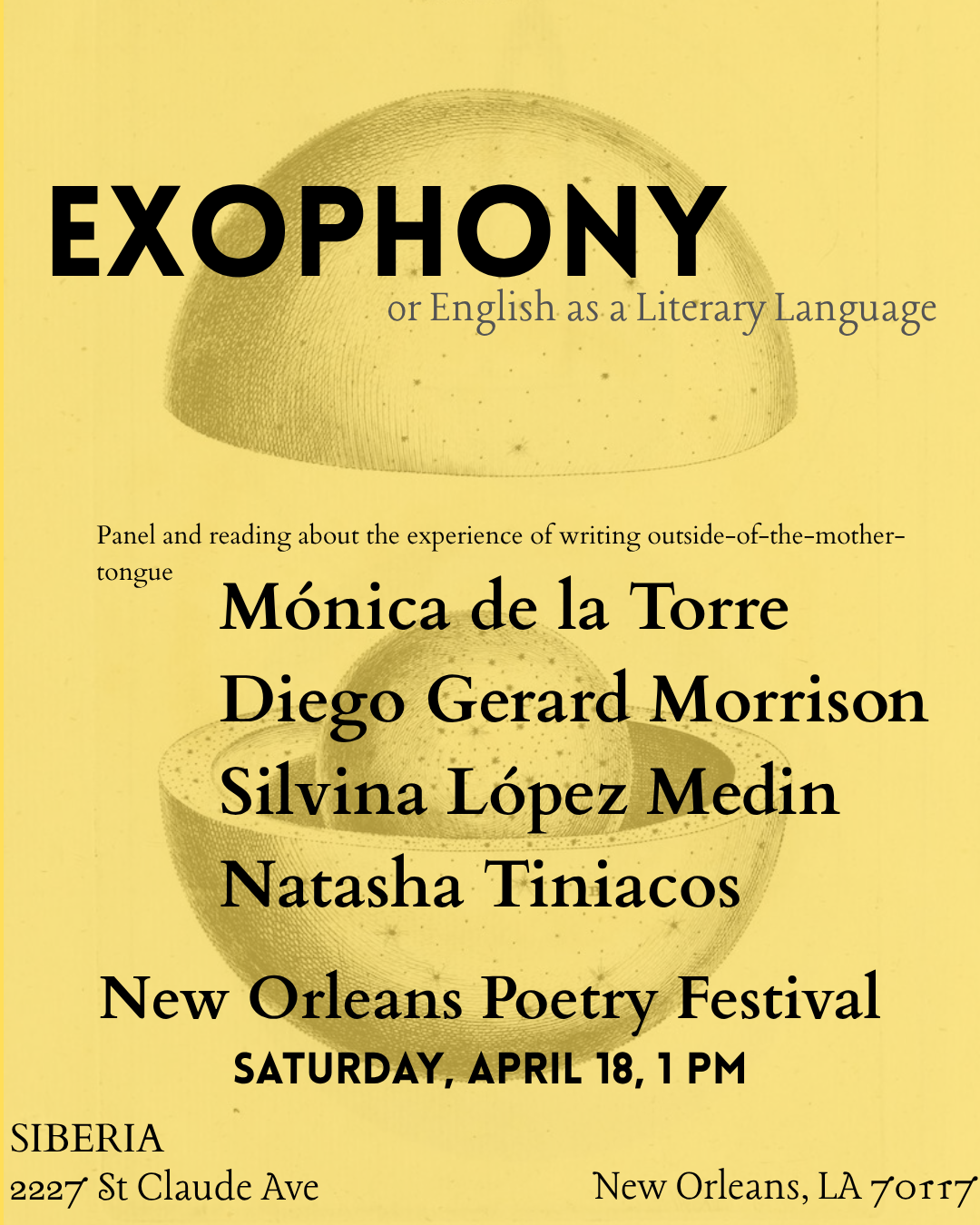
Some writers adopt the language of their place of exile or refuge: the Polish writer Czesław Miłosz wrote in English, while the Irish writer Samuel Beckett wrote in French. The Hungarian writer Ágota Kristóf, who also adopted French in her writing, explains in The Iliterate that this language gave her the necessary distance from the pain she felt for her homeland, Hungary. This is a poetry reading and a roundtable, an in-between for the sake of collective thinking about the phenomenon of literary exophony, defined as the general experience of existing outside one's mother tongue.
Mónica de la Torre (Mexico), Silvina López Medín (Argentina), Diego Gerard Morrison, and Natasha Tiniacos (Venezuela) think together their inclinations toward exophony and what lies behind that freedom of choice. Is it the impulse of circumstance or of language? A poem, at moments, decenters its origin. Why? They will read some of their poems written in the language a-partir-de-la-materna: English, shaped by the multilingual and multiple experiences of New York.
Siberia
The Literary Arts MFA cohort at Brown University presents “Dream Desires: Mirror / Blueprint,” a poetry reading that transverses dual sides of the meanings of the word “dream.” A dream may be a reflection of a wish or prediction received during sleep; it may also be a goal designed and acted toward during waking life. Magical or pragmatic, visionary or constructed, fragment or flowchart, portal or plan… these two definitions feel opposite, but proximate--both kinds of dreams echo our desires for the future. Sleep-dreams and awake-dreams also find a bridge in mysticism, which often manifests in practical, devotional actions. In this reading, poets will engage modes including incantation, confession, surrealism, scheming, and pep talk, to explore the multivalent offerings of our dreams.
St Roch Tavern
This reading will showcase poets and translators with work published by four NYC-based small presses: Beautiful Days Press, New Mundo Press, Topos Press, and Ursus Americanus Press.
AllWays Back
This reading continues a series that began more than two years ago, as poets from the United States visited Mexico City and read with Mexican writers at the small poetry-only community-run bookstore Librería Escandalar, a place where poets from different countries meet, hold readings, and exchange or leave books. These readings allowed us to get to know each other’s work, and to keep in touch since. Juan Malasuerte and Escandalar are two imprints associated with the bookstore, and a bilingual anthology of Latin American and U.S. poetry is presently being translated, with publication planned for 2026. It is a happy opportunity to be able to meet in person again, this time in New Orleans, and share these poems, and hopefully the anthology, with those present!
AllWays Front
2026 marks indie publisher Black Ocean's 20th year in publishing. Join us for a reading and panel discussion to celebrate this achievement and the many different books and authors that have found their home with Black Ocean over the years. The event will feature readings by longtime Black Ocean authors Nathan Hoks and Joe Hall, who will be reading from their new books, as well as poetry editor Carrie Olivia Adams, reading from new work from Tupelo Press. Following the reading, Dylan Krieger will moderate a discussion about what has made Black Ocean so special and sustainable over the decades and take questions on the future of poetry publishing.
Café Istanbul
The Louisiana French word lagniappe means “a little something extra.” In New Orleans, lagniappe is a gesture of generosity—a small bonus given freely, whether an extra shucked oyster, a long pour, or an unexpected kindness from a neighbor. This spirit of abundance and reciprocity resonates where poetry is not just a genre but a living practice embedded in community, resistance, and cultural exchange. These Lagniappe Readings celebrate this ethos, offering a space where six poets perform their work.
Kajun's Karaoke Bar, 2256 St Claude Ave
Kolaj Institute, 2374 St Claude Ave #230
This roundtable will explore how poets adopt or imbue personas, voices, or masks in their work and on stage—and how the shift into performance transforms the text, the writer, and the audience.
The act of poetic performance often involves a voice that is not strictly the “I” of everyday life–a voice that is dispersed, a voice that arrives from a split subject, an “I” that is a pun of many different composite “I”s; this roundtable will examine the generative possibilities of that invitation towards persona, invite reflection and discussion on where the “self” ends and the “voice” begins.
Some opening questions:
Multiplicity of the “I” — How does the poem make room for multiple or fractured selves? What happens when the “I” becomes plural, composite, or performative rather than confessional or autobiographical?
Voice as Threshold — How does voice act as a site of crossing between the written and the performed, the interior and the social, the living and the dead?
Mask and Revelation — In what ways does persona conceal in order to reveal, or reveal through concealment? How does the act of disguise invite new modes of truth-telling?
The Dispersed Self in Performance — How does performance re-animate or further dissolve the poetic self? What transformations occur when a written voice becomes embodied or voiced aloud?
Voice as Invocation — What kinds of presences enter when we perform a voice that is not our own? How does persona function as invocation, possession, or ritual speech?In what ways does performance (reading aloud, staging, movement) reshape the poem’s voice?
Voice as Clairvoyance / Divination — Can performance act as a form of channeling, a way of accessing or listening to the unseen? What is the relationship between voice and prophecy, between writing and the ritual technologies of mediumship? In taking on persona, do poets become translators of otherworldly speech—carriers for voices that do not belong entirely to them? How might divinatory poetics expand the notion of authorship toward something more porous, collective, or cosmological?
Format:
Short “lightning” sharing by each panelist: artist talk? Mini performance? Reading of one passage in which they use persona/voice in a particular way? 10 minutes each, 4 participants = ~40 minutes)
Moderated discussion with audience participation—questions like “When does the poem become a performance of voice rather than an expression of self?” (10 minutes)
Confirmed participants: Stella Corso, Valerie Hsiung, Bo Hwang, [Zack Darsee & Elise Houcek - as one unit]
NOHC 204
This panel explores how artists and scholars use non-linear storytelling to resist the dominance of white supremacy, colonial history, and cultural erasure. Linear narratives privilege coherence and permanence—qualities often aligned with the authority of the archive. By contrast, non-linear artistic practices and embodied actions open space for contradiction, silence, and multiplicity, aligning more closely with what Diana Taylor has called the repertoire: ephemeral, embodied, and improvisational forms of cultural transmission.
Panelists will share diverse approaches, from weaving with foraged plants and poetry to reworking archival fragments and theorizing family narratives. While the archive holds documents, objects, and records, the repertoire emphasizes performance, gesture, and the living act of telling. We ask: How can creative practices activate both archive and repertoire, not as opposites but as entangled modes of reckoning with history?
Our conversation will consider how weaving, collage, and performance-based methods disrupt the authority of “heroic” family stories, how gaps in the archive can be transformed into generative sites of inquiry, and how community-based projects can bring repertoire into dialogue with archival traces.
This session will be of interest to artists, scholars, and cultural workers engaged with social practice, memory studies, and racial justice. By weaving together practice and theory, the panel will highlight how art can counter the rigidity of whiteness and create spaces for accountability, repair, and new ways of belonging.
NOHC 300A
Léon Pradeau and Kai Ihns, editors of the bilingual journal Transat', welcome French poets and translators Vincent Broqua and Camille Bloomfield to discuss the role of translation in their poetic practice—and vice-versa. Broqua and Bloomfield have translated many American poets (including David Antin, Monica de la Torre, Rachel Galvin, Lily Robert-Foley, and Anne Waldman), and have weaved experimental translation practices into their own books, from homophonic translations to what Broqua has recently called "traduction louche" (shifty translation). Broqua is a member of the Double Change collective, one of the most important actors of the transatlantic conversation in France. Bloomfield is a member of the OuTransPo, a collective of translators focused on experimental and generative translation. Both are also scholars of translation. In this roundtable, we will discuss the role of translation in a globalized world as well as the growing threat of AI; we will also explore various translation styles and techniques that Broqua and Bloomfield have practiced in their career. For them and for Transat', translation is also an essential component of their own poetics, experimenting with ways for one's own writing to welcome another language and the words of others. Broqua and Bloomfield will also read short excerpts of recent work fueled by these experiments in translation.
NOHC 400
With a mission to publish strange poetry in translation and in English that would be unpublishable by other means, co•im•press is an award winning, nonprofit small literary publisher that started producing books in 2013. This reading features four of the press's most lauded poets and translators, including Gina Abelkop (author of i eat cannibals), Daniel Borzutzky (translator from the Spanish of The Loose Pearl by Paula Ilabaca Núñez and Valdivia by Galo Ghigliotto), Laura Cesarco Eglin (translator from the Galician of claus and the scorpion by Lara Dopazo Ruibal and from the Brazilian Portuguese of Of Death. Minimal Odes by Hilda Hilst), and Katherine M. Hedeen (translator from the Spanish of tasks and from a red barn, both by Víctor Rodríguez Núñez).
Siberia
FIELD TRIP is a literary project with the simple aim of bringing more poets to the Detroit area while, simultaneously, promoting the incredible local talent.
Detroit famously has a rich literary tradition. Field Trip draws inspiration from Detroit presses and literary organizations such as Alternative Press and Broadside Lotus Press, as well as many others.
Over the past year we have been honored to host writers such as Anne Carson, Noor Hindi, Tongo Eisen-Martin, Eleni Sikelianos, Carla Harryman, Zan de Parry, Kamelya Omayma Youssef, and Laaura Goldstein. Now we'd like to turn the tables slightly. Instead of bringing writers to Detroit, we are bringing Detroit writers on a Field Trip of their own.
Talia Gordon, Isaac Pickell, Ashwini Bhasi, Stephanie Sutton, and Raven Eaddy are poets based in and around Detroit. They are all Field Trip alum as well as writers actively writing and engaging in Detroit's literary community. The event is hosted and curated by poet Christine Kanownik.
St Roch Tavern
AllWays Back
Four poets, all featured in the anthology The Future of Black: Afrofuturism, Black Comics, and Superhero Poetry (Blair Press, 2021), will read their work and discuss how their poetics intersect African diasporic traditions, the Black speculative, and formal experimentation. Through the lens of Afrofuturism, these poets will demonstrate how persona poems can reclaim mainstream and Eurocentric narratives and heroes, and how imagining Black futures make real Black life today, reminding us the ordinary can be extraordinary, or as June Jordan once said, make clear the difficult miracle of Black poetry in America.
AllWays Front
Multi-media readings by experimental poets working with and against digital video.
With short form video content & live-streaming taking their places as the most consumed formats above all other media today, what shapes do poems take?
What is poetic form amidst post-literacy? Aliens, weapons of mass destruction, ear licking, recipes crafted by dosed detectives, 9/11, let's plays, the NBA, and auto-erotic exhibitionist tendencies have something to do with it.
Is visuality the new orality? Or something.
Statistics say that you spend 3 hours each day on social media and other statistics say video makes up 58.8% of that time. An average life is 639,918 hours. You do the math. And then come watch this.
Join thousands of creators, streamers, and fans to experience gaming, meet your favorite streamers, and be part of the ultimate creator convention. Get your selfie game ready. With hundreds of streamers, including faves and surprise guests, you've got options. Search the list and build your bucket list. Your favorite streamers are ready to meet you IRL at our Meet & Greet booths. Imagine a festival of streamers and folks from chat, all coming together. Yeah, that's right, a place for you, your friends and the streamers you love to hang out for a weekend of games, meet & greets, networking, creating, learning new skills, live esports, the Loot Cave, and so much more. Made for the community, by the community. It's here that you'll find the stars on stage, learn how to improve your stream, discover the latest from the biggest brands on the expo floor and chill with new and old friends. You'll need a reservation to get in.
Café Istanbul
The Louisiana French word lagniappe means “a little something extra.” In New Orleans, lagniappe is a gesture of generosity—a small bonus given freely, whether an extra shucked oyster, a long pour, or an unexpected kindness from a neighbor. This spirit of abundance and reciprocity resonates where poetry is not just a genre but a living practice embedded in community, resistance, and cultural exchange. These Lagniappe Readings celebrate this ethos, offering a space where six poets perform their work.
Kajun's Karaoke Bar, 2256 St Claude Ave
In Inciting Joy, Ross Gay writes, “What if joy, instead of refuge or relief from heartbreak, is what effloresces from us as we help each other carry our heartbreaks?” After the community joy and success of last year's workshop, we return to the New Orleans Poetry Festival to bring "Where We Come Together." This gathering is an ekphrastic workshop that is part short film screening, part guided writing prompts, and most of all, a space we might create together for our reflection and healing. Focused on the multifaceted reality of the present moment–that someone is being born right now, that someone is dying, that someone feels the greatest pleasure of their life– and our deep ecological connections, this workshop will use Liz Williams-Trader’s short film to encourage participants to reflect on their greatest joys and greatest griefs. We will write them together and emerge different.
The first half of our workshop will begin with a screening of Liz Willliams-Trader's short experimental film, Where We Come Together (5:20mins). Created from overlaying the artist's portraiture with video from an outdoor camera, the film achieves a deeply moving and paradoxical reflection on life, culture, death, as the viewer watches life beautifully continue through and beyond our personal griefs. Workshop participants will then be guided through two structured and approachable writing prompts based on the film. If feeling is transformational, and art captures and provokes feeling, we are sharing this film and incanting our writers towards writing poems of joy and grief so we each might leave grounded, in touch with ourselves, and yes, changed.
We gather with you to generate writing, yes, and also, something good and healing. This workshop is devoted to the multifaceted unflinching study of the present moment's beauty, grief, and the reality that we are each transformed by feeling what is.
As a group of artists, we understand that our larger present moment would not be possible without disassociation on a large scale, and we understand that encouraging Presence and Creativity are antidotes to the ways we violate ourselves and others when we live in numbness. In this way, we hope and know this workshop together will bring waves of positive change that will last longer than our beautiful festival.
Timeline for this Workshop:
10 min introduction to the artists, 5-7 min intro to film
6 min watch film, 25 min first prompt grief
8 min sharing first prompt
6 break
6 min watch film, 25 min second prompt joy
10-15 share work and discuss how these prompts talk to each other
Kolaj Institute, 2374 St Claude Ave #230
Not often associated with poetry, horror’s genre elements can cut a poem open and make it bleed. Through embodiments of the grotesque, the Gothic, and the uncanny, panelists will discuss manifestations of the horror genre’s multifarious, mutating influences within their work. Where does horror lurk in historical and contemporary poetry and what possibilities does it offer poets as a means of exploring the past, trauma, speculative futures, and self-determination? What is the role of horror in contemporary poetry? Is it having a “moment” or has it been with us all along? The panel will explore the poetics of body horror, abjection, incantation, disturbance, and other horrific tropes, as generative praxis and access points to greater understandings of subjectivity and social identity, the living and the dead.
NOHC 204
Five poet-curators, Lee Ann Brown and Tony Torn (Tender Buttons Press/Torn Page), Jennifer Firestone (Poetry on the Porch), Philip Good (Poetry State Forest), Evelyn Reilly (OtherWords) will discuss their visions and aesthetics on the curation of unique poetry readings in non-traditional spaces. They will address what makes for a compelling poetry reading experience that is accessible to different communities, and how such readings can in turn develop new forms of social connections around poetry, ranging from the intimate to the expansive. Each poet of this roundtable will share their curation process, highlight examples of specific successful and unsuccessful readings, and share ideas on how to generate such reading experiences in other locations.
NOHC 300A
Group reading of recent Tripwire writers, translators, and editors, celebrating several new Tripwire publications (journal, pamphlets, and books). Featuring David Buuck, Hugo García Manríquez, Erasmo Pantoja, Irene Silt, & more---
NOHC 400
As bell hooks writes it, “To be in the margin is to be part of the whole but outside the main body.” In hooks’ black feminist theory, the movement from margin to center, describes an agential political relationship to spheres of power, but how does this movement, from center to margin, also translate into a poetics of extension, rupture, and adjacency? More specifically, in what ways does the margin(al), or what Gerard Genette gestures toward as the paratext’s “zone between text and off-text,” activate forms of mimetic performance from/to the periphery, whether in the simulation of the nonliterary, the nonverbal, and the aphasic, in the extension of the body and the organic world into typographic (and choreographic) space, or in the compression of informational paranoia into hexagrammic concision? In this poetry reading and discussion, Hannah Brooks-Motl (author of Ultraviolet of the Genuine, 2025), Geronimo Sarmiento Cruz (author of whalefall, forthcoming 2026), Sara Wainscott (author of The Star Cabins, forthcoming 2026), and Jose-Luis Moctezuma (author of Black Box Syndrome, 2023) will read work from their latest projects that interrogate the limits of the marginal and the mimetic.
Siberia
Readings by authors and/or translators from recent Lavender Ink and Diálogos books. Robert Fitterman and Roberto Balò will read from Balò's forthcoming Saga, translated from the Italian by Fitterman. Olga Mikolaivna reads from her forthcoming translation of Ukrainian poet Stanislav Belsky, There Will Be No Culmination. Translator Piotr Florczyk read from Hemorrhages & Squirrels, by Jakub Kornhauser. Ann Plique reads from the newly released New Barrier Islands. Indran Amirthanayagam reads from his translation of Mexican poet Kenia Cano.
St Roch Tavern
NOPF presents our main event with poets JJJJJerome Ellis and Courtney Bush. Through music, performance, and writing, Ellis explores what stuttering can teach us about listening, generosity, and justice, creating contemplative soundscapes and music-video-poems that transfigure sound and time. Bush, a poet and filmmaker, is the author of four poetry collections including I Love Information (winner of the 2022 National Poetry Series) and most recently A Movie and The Lamb With The Talking Scroll. Performances begin at 8pm on Saturday, April 18th, at Siberia, 2227 St. Claude Ave, New Orleans, LA. This event is free and open to the public. Funding for this event has been provided by the State of Louisiana and administered by the Louisiana Endowment for the Humanities.
Siberia, 2227 St. Claude Ave
Small Press Fair (10:00 AM – 4:00 PM): Browse and buy from dozens of independent publishers, zines, and literary journals in the Grand Hall of the New Orleans Healing Center. Meet the makers, discover new poets, and support independent publishing culture.
Grand Hall, New Orleans Healing Center, 2372 St Claude Ave
Since 2018, Kolaj Institute has investigated the intersection of Poetry and Collage through a series of artist residencies that resulted in the journal, PoetryXCollage. Now in its eighth volume, in the periodic journal of artwork and writing, we are interested in found poetry, blackout poetry, collage poems, haikus, centos, response collages, response poems, word scrambles, concrete poetry, scatter collage poems, and other poems and artwork that inhabit this world. In 2026, Kolaj Institute is presenting its first exhibition of artwork from the intersection of Poetry and Collage, "Fragment as Verse". In the exhibition, we consider the role fragment plays in both mediums and how artwork at the intersection operates on the gallery wall. Using the exhibition as a point of departure, participants in this workshop will dive into Kolaj Institute's material library and make collage at the intersection of Poetry and Collage. We will talk about and make black out poems, found word poems, and a collaborative scanograph poem. The workshop will be led by Kolaj Institute Director Ric Kasini Kadour.
Kolaj Institute
Presented in partnership with the Literature Translation Institute of Korea (LTI Korea) through the KL Wave International Exchange Grant, please come experience the poetry of two contemporary Korean poets in this bilingual reading: Lee Jenny, who has pushed Korean poetry to new horizons by shaping waves of language into poetic, auditory rhythms that go beyond meaning; and Yoo Heekyung who is well known for revealing the strangeness of the world through the unfamiliar feelings and sensations found in our daily lives. Lee Jenny and Yoo Heekyung will read from their poetry collections Pirowa Padowa (Saturnalia Books, 2025) and Today's Morning Vocabulary (Zephyr Press, 2025), respectively, and will be joined by their English translators Archana Madhavan and Stine An. Lee’s poetry deconstructs conventional grammar and syntax to expand our universal notions of language. Yoo’s poetry are songs about death and memory; volition and the unfixed; loneliness and loss—human conditions that cannot mix but are not opposed to each other. You are invited to explore a new world, one that has stemmed from Korean and grown beyond language.
NOHC 204
The poetry world has entered into a new period of severe financial crisis. As federal funding for the arts retreats, presses, poetry centers, and academic programs are having to make hard decisions about how and what to cut. So far, the response to this crisis has been largely business as usual—more calls for donations, more private money of questionable provenance sloshing around to cover the shortfall. One might say that this reflects the limitations of our institutional imagination. In the face of an existential crisis, the liberal establishment that governs the poetry world, like the liberal establishment more broadly, falls back into a posture of retreat, defending institutions and practices which are, obviously, bankrupt, morally and financially.
The roundtable begins with an open question: Why should we defend the institutional poetry world that has come into being since the late 1970s, with its culture of scarcity and prestige? The poetry culture we operate within has dramatically failed to make poetry a livable practice for most working poets—concentrating resources in the hands of a very small minority who are able to command major prizes, honoraria, and stable teaching jobs. The results for the art itself have been predictable and abysmal. We all know people who have left the art because it is impossible to make a life here; likewise, we all know people whose values have been corrupted, utterly, in their pursuit of prestige and power within the poetry world.
To quote the former mayor of Chicago, Rahm Emmanuel (himself an architect of our current liberal episteme), "Never let a good crisis go to waste." What if, instead of, defending our institutions, we radically reimagined them? What would a poetry world that is just, equitable, open, democratic, look like? How could we make solidarity and mutual aid the basis of our lives as poets? In what spaces within the poetry world are poets and organizers already practicing viable alternatives to the neoliberal structures which have otherwise dominated our field?
This roundtable discussion, co-organized by Annulet and the RCAH Center for Poetry at Michigan State University, is intended as a place to pose these questions, and to imagine their answers; to engage in utopian dreaming and to get into the nitty-gritty practicalities of alternate institutional structures and possibilities. Our panelists include a wide range of figures in the poetry world, from institutionally secure professors to graduate students facing a bitter job market; from poets who lead or work within existing institutions to those who operate beyond them or are imagining new ones. They come together to ask the pressing question we should all be asking in this moment of crisis: what kind of poetry world should we have?
Kay Gabriel will talk about the history of the Poetry Project as an anti-war cultural organization, which for 60 years has linked culture workers to political consciousness and movement organizations and makes it possible for us to be effective in ways we otherwise couldn't have been. She will draw on the history of the Project that I've gone deep on while on staff here, and she'll talk about the origins of the Project out of the anti-Vietnam war movement, organizing in the 80s in solidarity with Nicaragua and the movement against apartheid in South Africa, and our more recent PACBI commitment.
Stephen Ira will speak about youth poetry outreach as a potential technology of trans social reproduction. Right now, we have a conversation about trans youth where the conservative side is dominated by moral panic, and the liberal one by a medicalized concept of trans childhood imposed upon trans people by heterosexual institutions. Trans children need neither of these--they need access to intergenerational connections with trans adults. In other words, they need access to the forms of trans social reproduction that are in fact being described by fascists when fascists use the term "grooming." How can the poetry world provide these spaces to youth, insuring they are not only accessible, but populated by trans working artists? In his current work in youth outreach as the Youth Services Co-Ordinator at New York City's Poets House, a literary non-profit and free poetry library, he will attempt to answer these questions.
Kelly Krumrie will discuss pedagogy, focusing on the actual pedagogical practices that have radical impacts within institutional spaces today. For all of our "radical" thinking, most of us aren’t great teachers in practice and blame the students and the environment/institution for our failure to respond creatively, empathetically, and without ego. In response to current shifts in academia (e.g., AI) and the reimagining of poetic institutions and practices outlined in this panel description, she believes we need to do a bit of un-learning as educators so that we can re-teach our students. Poetry, more than any other genre, allows this to happen.
Aditi Machado will focus on some of the actually nice things *** that have happened working with students (undergrad and graduate) and use those "outcomes" to imagine a set of classes she would love to teach but the university won't allow. She will also address how one tries to game the system or sneak in practices that are antithetical to university logics as a result of this constraint that reinforce the dynamisms of unruly poetry learning communities. ***Actually nice things: undergrads starting their own writing groups or open mic series off-campus; undergrads learning to acquire rare/special editions for the library; graduate students' experimentations (ex. ritualistically burning their dissertation); and a range of small but crucial acts that accumulate—and give Aditi some hope that those of us stuck in higher education might catalyze practices that move beyond pobiz as usual.
Nora Claire Miller will discuss Somehow School, the creative writing school/studio space for kids and teens that they recently started. Of their project, they say: “I think there should be a lot more poetry in the world world and not just the poetry world, which means we need to get more kids reading and writing poetry. The robots are coming for critical thinking, but one thing robots suck at is writing poems, because actual poems are just so WEIRD. The earlier kids learn that there’s an arbitrary relationship between signifier and signified, the better equipped they’ll be to fight fascism.”
Nick Sturm will describe the conditions in the late 1960s and 1970s that produced the institutional network of literary nonprofits that shape the field going forward. Nick will offer a brief history that tells us how the National Endowment for the Arts constructed Poets & Writers, CCLM/CLMP, AWP, and others, and how each of these nonprofits, undergirded by state funding, created American poetry's professional infrastructure. Nick's presentation is less invested in critique here than diagnosis—actually seeing and describing this history to identify macro trends and offer more nuanced origin stories for some of the crises you bring up. Part of the tension in this story about the development of the field's nonprofit organizations is seeing how these actors responded to alternative communities that both resisted and participated in those organizations' projects, often in more complicated ways than we might imagine.
Alicia Wright will focus on the fundamentally anarchic/agentic nature of the literary journal, which is an actively recombinant form through which we might think about what’s emergent in our political and aesthetic present in both its disparately composed and structurally shared expression. The literary journal, both in print and online, is the site where these two channels meet, and where we can best see the literary world organizing itself. Through a journal’s fluctuations, we can track its individual divergences, alignments, inherences, and disruptions of both experimental and mainstream poetry culture. A journal can puncture, and punctuate, these logics of affiliation and organization. Through its aggregate nature, Alicia will also argue, literary journals act as antidotes to machine-driven writing that’s stripped of its human, and subsequently its political, viability. The future of poetry in the U.S. begins with this essential form’s foundational, heterogenous, and de-institutionalizing work.
S. Yarberry will discuss what they are calling "Poetics of the Event." S. talk about literary events as sites that should move further into experimentation and disruption. For instance, "the poetry reading" has become an expectation: there is a host, someone reads, someone else reads, they sit down together and host a conversation, then take Q&A. We drink a little tiny glass of wine and eat a cookie, then go off into the night. Event over. This idea of "the poetry reading," then, has become a set of constraints, not unlike a sonnet or pantoum. These constraints that have been rearticulated over and over again, regardless of the content to which they are supposed to coordinate: should the poetry event for Aditi Machado look structurally the exact same as a poetry event for Yanyi? You'd think not, and yet this is often the case. In "Poetics of the Event," S. will call for a push for literary organizers and poets themselves to approach the event of poetry with as much imagination as one approaches the poem itself.
The panel will be moderated by RCAH Center for Poetry Director, Toby Altman.
NOHC 300A
Seeking a writing life, with time to read and write and some institutional health insurance, a poet might send herself to school. What happens then? This panel explores how research that’s presumed to be objective and scholarly inevitably bleeds into the more subjective realm of poetry as result of creative and critical life’s entwinement. While the academy offers a mirage about the promises of the life of the mind, it also places a series of material hurdles and limitations in front of the would-be scholar-poet: debt that necessitates work, disciplinary prohibitions on creative-scholarly work, very few prospects for gainful employment after graduation, and loads of service work for those who are lucky enough to get a job. For many, the dissertation is the first and last chance to do the kind of immersive intellectual work promised by the academy. This panel examines the creative shadow lives and afterlives of that research in a precarious economy that allows very few people time for writing, much less research, asking how poems can recuperate research and knowledge-making that academic institutions ultimately discourage. This panel of academic and ex-academic poet-scholars asks: How does scholarship bleed into, infect, or re-shape poetry? What is the writing that comes out of the intertwining of these two pursuits? How can we foster inclusive cultures of research and deep engagement with ideas in and through poetry, but outside of official institutions?
NOHC 400
Presented in partnership with the Literature Translation Institute of Korea (LTI Korea) through the KL Wave International Exchange Grant, in Seoul, the city of K-pop, you’ll find poems featured on every subway platform door. On its main streets, lined with huge LED screens, new verses are displayed every couple weeks. People pause to read those verses and fully feel the change of seasons. For Koreans, poetry is part of their everyday landscape and lives, a part of their collective spirit they’ve long preserved. Even in this dopamine-addled era where everyone is glued to their smartphones, new poets continue to emerge steadily in Korea and new poetry collections are being published. New poetry and new poets are incredibly well loved by the new K-pop–loving generation. Join Lee Jenny, Yoo Heekyung, Stine An, and Archana Madhavan as we explore why Korean society craves poetry so deeply. They’ll also examine the unique history and environment surrounding Korean poetry that allowed poets such as Kim Hyesoon, Han Kang, Lee Seong-bok, and Yi Sang to emerge from within literature written in Korean, a minority language. You too may find yourself captivated by the charms of Korean poetry.
Participants: Lee Jenny, Yoo Heekyung, Stine An, Archana Madhavan
Roundtable discussion: 40 minutes
Audience Q&A: 10 minutes
NOHC 204
"It's Copperhead Season(s):" Collaborative Composition, Shared Snake Stories, Poetics of Performance
Across a little over two years, 16(ish) poets have participated in one way or another in a collaborative composition process and a performance resulting from that process for the online series called "It's Copperhead Season." The collaborating pairs are sorta-randomly matched and given a few months to share ideas, swap poems, construct something new together, and ultimately perform some live document of their writerly connection(s). Participants have generated a myriad of poetic forms, visual and sonic experiments, an interactive role-playing game, and other viper-potent combinations both familiar and strange.
In the "It's Copperhead Season(s)" Round(about)table, a gathering of these participants from across the series will share from their collaborations and experiences and spark new connections in a discussion on writing and art-making in resonant frequencies.
This heady celebration of past and future consanguinity will feature readings, performances, serpentine wisdom, tarot practice, mixed mediumship, live role-playing games, and/or slithering nonsense from some of the participants including Danika Stegeman, Joe Hall, Jace Brittain, Lindsey Webb, Mike Bagwell, Paula Cisewski, and others. Collaborators have also included Olivia Muenz, Yanara Friedland, Isaac Pickell, Matt Hart, Karen Rigby, Jacob Reber, Dom Witten, D.C. Klein, Kelly Hoffer, and MC Hyland. Jacob Reber designed all of our previous posters, visual materials, glitches, and visions.
NOHC 300A
Poets from Brazil, France, and Ukraine come together with their English-language translators to discuss their work and their collaborations. This panel will showcase recent books by Ricardo Domeneck and Chris Daniels, Anna Malihon and Olena Jennings, and Marie de Quatrebarbes and Aiden Farrell, all published in the last year by World Poetry.
NOHC 400
Fence Books, born in 2001, after Fence was founded by Rebecca Wolff in 1998, celebrates its 25th Anniversary in 2026. This celebratory reading features poets sharing their work from Fence Books over the years: Steven Alvarez, author of The Codex Mojaodicus (2017), Kathryn Cowles, author of The Strange Wondrous Works of Eleanor Eleanor (2026), Amanda Deutch, author of new york ironweed (2026), and Martin Corless-Smith, author of Nota (2003), English Fragments: A Brief History of the Soul (2010), and Bitter Green (2015), introduced by Editorial Director & Books Editor Emily Wallis Hughes.
AllWays Back
This reading and performance event will feature the work of four poets writing against empire. "Against" here resonates not only as a preposition, expressing relation and the fact that empire is the prevailing environment, the primary constitutive force of the world-system, but "against" also indicates the ardent anti-imperialism that motivates and shapes the poetics of these four poets. The reading will engage and indicate different angles of attack, and a diversity of aesthetic tactics in expressing & embodying critique of empire and US imperialism. These poets' work each engages, and confronts different aspects of US imperialism including the so-called Global War on Terrorism; the destructive consequences of colonization & imperialism for (world) ecologies; the on-going imposition of US power in Latin America; and the US political and material facilitation of the genocide in Gaza, and the continuation of the occupation of Palestine.
AllWays Front
The Louisiana French word lagniappe means “a little something extra.” In New Orleans, lagniappe is a gesture of generosity—a small bonus given freely, whether an extra shucked oyster, a long pour, or an unexpected kindness from a neighbor. This spirit of abundance and reciprocity resonates where poetry is not just a genre but a living practice embedded in community, resistance, and cultural exchange. These Lagniappe Readings celebrate this ethos, offering a space where six poets perform their work.
Kajun's Karaoke Bar, 2256 St Claude Ave
This workshop explores the particularities of writing poetry with a bilingual brain that navigates between two voices, two languages, and often two personalities. Although the facilitator is a bilingual Mexican poet writing in Spanish and English, poets of all language backgrounds are welcome. The workshop will start with a 15-20 minute discussion circle, where we will introduce each other and reflect on how we inhabit language, whether we are monolinguals, bilinguals, or polyglots.
The poet/facilitator will then share some examples of bilingual poems, including poems of her own, to explain different approaches to writing in two languages and self-translation. We will then explore the possibilities of bilingualism as a metaphor and as part of a greater network of liminal identities. In the poet, there are parallels between how she inhabits being bilingual, being bisexual, and living with a BPD diagnosis. Dialectical behavioral therapy provides a model for holding two truths at once that is useful for understanding both bisexuality and bilingual brains, as well as its intended purpose of helping neurodivergent people navigate a normative world.
The poet will encourage workshop participants to find “incongruous juxtapositions” and dialectical dualities in their own identities and life experiences, considering the cultural, the geographical, and all the situations in which code-switching occurs to create a poem that somehow maps their bilingual (or other-lingual) brains. The poems will be free in form, but there will be collage materials to encourage playfulness, multimediality, and self-expression.
The “theory” part of the workshop should take roughly 50 minutes, leaving an hour for the “practical” segment: 30 minutes to create their poem, followed by 30 minutes of sharing (final pieces, closing reflections, or both). Segment times may vary, but the workshop is designed to last 1 hour and 50 minutes.
Kolaj Institute, 2374 St Claude Ave #230
Acknowledging the generative potential of traversal, this roundtable centers on walking as a somatic writing practice and poetic technique. The five poets on this panel are interested in the interrelationship between physical movement and the emergence of thinking and language and consider such things as the commons in times of privatization, the sacred in a time of environmental degradation, the ways in which that act of walking with and walking alongside impacts and disrupts habits of attention, and tensions between the ideal walk, “in which the mind, the body, and the world are aligned” (as Rebecca Solnit describes in Wanderlust) and the “unideal walk,” where mind, body, and world are not aligned and can’t align for various reasons—practical, ethical, or political.
NOHC 204
This panel looks at the legacy of the Mongrel Coalition Against Gringpo—an anonymous collective of writers who took to X (formerly Twitter) in 2015 to challenge what they saw as the white supremacist ethos of conceptual poetry—a decade after their formation. Although short-lived, the Mongrel Coalition’s distinctive all-caps styling and combative tone sparked intense discussion and debate about the racial politics of avant-garde movements and of official institutions of poetry, with some finding their activities appropriately pitched to the severity of their accusations and others accusing them of targeted harassment, including of writers of color. We will discuss the group in terms of its aesthetics strategies, its implications for the state of the poetry world today, the difficulties of historicizing contemporary literary movements, the uniquely online circulation (and disappearance) of its work, and its place in the fraught lineage of the avant-garde.
NOHC 300A
Famously, Derrida wrote: “Why archive this? Why these investments in paper, in ink, in characters? Why mobilize so much space and so much work, so much typographical composition?”
In archives we find a record of our lives: what has touched and made us. From newspaper clippings and Vietnamese language workbooks to pre-1900s seed catalogues and daily gym logs, we will explore how familial, historical, and personal records inspire and inform our storytelling and how there are, as Derrida writes, “stories to be had everywhere.” Our archives are glimpses of our selves—of what we choose to keep, to store away, and return to.
But when memory or records fall short, how does poetry help us fill in the gaps? And how can poetry become, in Ann Cvetkovich’s words, an archive of feeling? In this roundtable, we will discuss how working alongside archives allows us to preserve culture and memory, subvert expected narratives, and transform the seemingly mundane into critical documentation. We will examine not only how archives connect us to the past, but also their potential for building a pathway into the future.
NOHC 400
The APARTMENT Poetry high-rise has been steadily climbing since 2013. To celebrate, we present a reading, hosted by APARTMENT editor Michael Joseph Walsh, featuring some of APARTMENT's most illustrious and multitude-containing tenants: Jace Brittain, Stella Corso, Paul Cunningham, Jane Lewty, Aditi Machado, Danielle Pafunda, Michael Martin Shea, Danika Stegeman, and Elise Thi Tran. APARTMENT thanks you in advance for your attendance. As we're always saying: If you lived here, you'd be home by now.
Siberia
This poetry reading highlights contemporary Latin American poetry that actively shapes visions of sustainable collective futures in the face of climate and political crises. Contemporary poets Eliana Hernández Pachón (Colombia), Nicole Cecilia Delgado (Puerto Rico), Ariel Francisco (US, Guatemala, Dominican Republic) Carlos Orellana (Guatemala), and Carolina Sánchez (Colombia) employ archival and documentary approaches to register and reimagine environmental realities—including hurricanes, extractivism, resource scarcity, machines, consumption, and forced migration—demonstrating poetry’s unique power to imagine alternative futures and foster ecological care. This reading will bring together local US and Latin American poets (Carlos Orellana, Ariel Francisco, Nahum Villamil, Carolina Sánchez) and two invited poets (Nicole Cecilia Delgado and Eliana Hernández), who will be in town to present their work at Tulane University. This will be a bilingual reading in Spanish and English. Nahum Jose Villamil Garcés will moderate.
St Roch Tavern
We are interdisciplinary poets and poet-artists interested in resistance as well as the generative impossibility of resistance. Our work engages the negative capability of non-dominant forms of life to create the thinking space and creative gesture of emergent anti-fascism, particularly through queer feminist archives. We are interested in the unformed or dissembled ground that is potent and generative of new ways of perceiving, articulating and being.
AllWays Back
Second Factory, now in its seventh issue, is the annual journal of Ugly Duckling Presse. 2F publishes poetry, visual art, and translation by artists and writers worldwide. The work we are drawn to reflects UDP's love of the mangy, the feral, the subcutaneous, the full-bodied, the otherwise-unpublishable, and is selected by a rotating crowd of UDP editors, friends, apprentices, and other shadows—whoever happens to be on the floor when it comes time to put it together.
Though we have been publishing Second Factory for seven issues and going strong, this is our first reading since 2022 and the first IRL. In New Orleans we will bring together contributors representing all 2F issues and all corners of the (poetry) world. Each poet will present a short work, around a minute in length. We are looking forward to meeting each other in the flesh.
AllWays Front
The Louisiana French word lagniappe means “a little something extra.” In New Orleans, lagniappe is a gesture of generosity—a small bonus given freely, whether an extra shucked oyster, a long pour, or an unexpected kindness from a neighbor. This spirit of abundance and reciprocity resonates where poetry is not just a genre but a living practice embedded in community, resistance, and cultural exchange. These Lagniappe Readings celebrate this ethos, offering a space where six poets perform their work.
Kajun's Karaoke Bar, 2256 St Claude Ave
In this generative class, poets Kelli Russell Agodon and Melissa Studdard help you step into the strange by guiding you through exercises designed to help you access the subconscious and surprise yourself on the page. We’ll explore techniques of surrealism—from startling juxtapositions to dream logic, associative leaps, and how to transform the ordinary into the extraordinary. We’ll look at how surreal imagery can deepen emotional truth and add new dimensions to your poems. Participants will leave with at least three new poem drafts and fresh ways to invite wonder and beautifully bizarre into their writing. All poets welcome—no prior experience with surrealism needed.
Kolaj Institute, 2374 St Claude Ave #230
Translation projects often come to us, as both readers and translators, through the small press–a series of personal exchanges, books and broadsides passed in and out of communities through editors, friends, and colleagues. These networks have long circumvented publishing’s imperial centers, nurtured alternative paths of production, and ushered in a future wherein “[t]he larger English becomes, the less it retains what previously constituted its Englishness.” (Jieun Kiar) These four translators, each writing from different locales in the west, will discuss the role of the small press and handmade book object in the work of translation now and account for how they each participate in an ever-increasing translingual world.
NOHC 204
This roundtable features five emerging and established, multigenerational BIPOC writers who simultaneously mark, push against, and make permeable the concept of genre and poetry genre boundaries. Starting with the question: “Is genre as much a performance as identity?” They will discuss the potential benefits and pitfalls of writing within genre constraints, and perhaps even challenge the notion of form as destiny. Panelists include Rob Arnold, jason b. crawford, Jennifer Maritza McCauley, Anastacia-Reneé, and Rone Shavers.
NOHC 300A
Divinatory poetics is a writing practice rooted in encounter. It engages uncertainty and the invisible as generative conditions of relation rather than threats to be solved, controlled, flattened, or monetized. Through ritual attention and oracular methods, the page becomes a site where dream, memory, ancestry—both known and unknown, gather. Meaning emerges through close listening and creative risk: an attunement to the charged drift of what moves between bodies, histories, and worlds.
Queer counter-prophecy interrupts the patriarchal architecture of prophecy, which relies on hierarchy: one voice, one truth, one authorized future. Queerness refuses these structures and instead turns toward forms of knowing that are plural, contingent, emergent.
This panel explores divinatory poetics as a practice of becoming-with: a methodology that turns writing into a collaborative encounter with what exceeds us.
It asks how queer, feminist, and diasporic lineages of divination unsettle dominant narratives of futurity—and how they enact alternatives grounded in relation, collectivity, and the still-possible.
NOHC 400
mercury firs publishes poetry, translation, and whatevfir else... Founded in 2022, with an online journal published semiannually and chapbooks sporadically, mercury firs foregrounds exploratory work to expand the thinkable… inside the outside….
This reading, hosted by mf editor and New Orleans-based poet, Ian U Lockaby, features poets and translators who have recently contributed to the journal, including: Elijah Jackson, Courtney Bush, Eric Tyler Benick, Ebs Sanders, Tessa Bolsover, Jackson Watson, Léon Pradeau, Vincent Broqua, Ryan Skrabalak, Madeline Zuzevich, Mike Bagwell, Katherine Gibbel, & Joel Craig.
With mercury lungs and firgotten futures, mf ers emerge and converge....
((Read more at mercuryfirs.org))
Siberia
For 50 years, BOA Editions has published poets whose work is dynamic, eclectic, and engaged with the pressing complexities of our times. Since its founding in 1976, BOA has published more than 300 books of American poetry, poetry-in-translation, and short fiction, and its list crosses the typical divisions of the contemporary literary world, comprising writers who innovate in a wide range of modes and forms. Among BOA’s initiatives is the Blessing the Boats Selections, named for the work of BOA author Lucille Clifton, a series that brings the vital work of women of color to broader audiences. At this reading, six BOA poets—Keetje Kuipers, Michelle Phuong Ho, Danni Quintos, and B.K. Fischer—will read selections that represent the scope of BOA’s diversity across identities, cultural backgrounds, aesthetics, and geographical regions.