Event Type
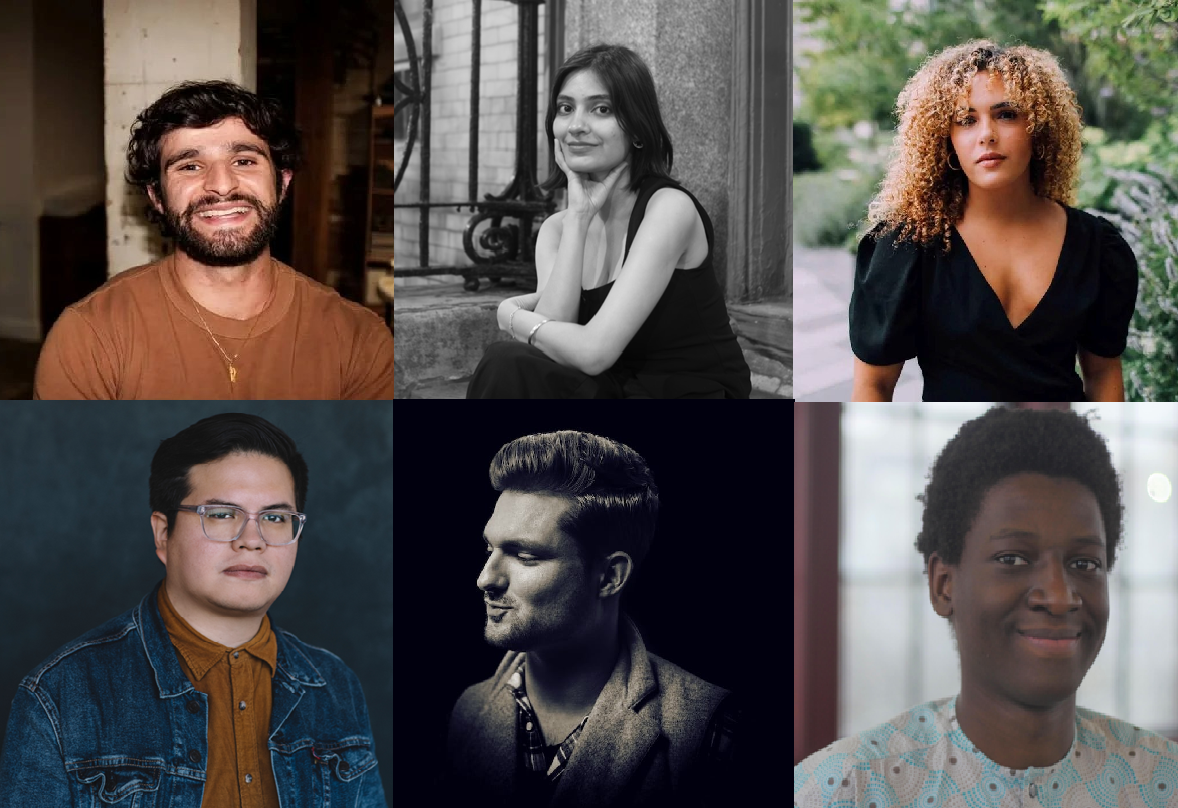
One defining characteristic of the ecstatic is what scholar D.J. Moores calls “radical self-transcendence”: a desire for which has frequently called readers to poetry, even across distinct literary traditions. Yet, despite ecstasy being a traditional poetic subject, poets today are still finding ways to renew this rupture of—and also beyond—self. In this reading, five emerging poets—Darius Atefat-Peckham, Gauri Awashti, Isabella DeSendi, Sebastián H. Páramo, and Phil SaintDenisSanchez—will dive into the role of ecstasy in their writing. Drawing upon both the modern and etymological definitions of ecstasy—the latter being "ex-" out of and "-stasis" immobility—these poets inhabit ecstasy through their respective cultural heritages in deeply personal but refreshingly novel forms.
Darius Atefat-Peckham will read from Book of Kin (Autumn House Books, 2024), a hauntological chronicle of living through grief, and also a formal assemblage finding relation between Sufi mysticism and deep gratitude in the joy of ordinary experience. Gauri Awasthi will read from The Mother Wound (forthcoming Trio House Press, 2026) a collection which memorializes the generational trauma of women through the rhythm of Indian classical music, and whose subtle manipulations of time recall the dreamy logic of film montage. Isabella DeSendi will read from Someone Else’s Hunger (Four Way Books, 2025), a powerful, transmutative work that seeks and its earn its moments of bliss; poetic crescendos that often begin as whispers before blooming into full song and dance—pulled from both deeply personal experiences and the recesses of ancestral and familial stories and hardships. Sebastián H. Páramo will read from Portrait of Us Burning (Curbstone Books, 2023), a kaleidoscopic lens capturing a working-class Mexican-American family in Texas through profoundly uttered and thoroughly embodied melodies of a troubled but deeply loved lineage. Phil SaintDenisSanchez will read from before & after our bodies (Button Poetry, 2025), illuminating the essential joys woven into growing up in New Orleans and the celebrations invoked by his ancestral connections and paths tracing back to the earliest Creole communities in Louisiana.
These writers seek to score the trajectory of release and cadential resolution in poetry that becomes all the more vital in the context of contemporary alienation and the imperialist machinery that subsumes so much of the joie de vivre embedded in organic culture. Tawanda Mulalu, author of Please make pretty, I don’t want to die (Princeton University Press, 2022), will introduce the poets and then moderate a brief Q&A to conclude the reading.