Event Type

"Theresa, I Miss You," is a durational installation/performance piece, part of an evolving body of work dedicated to Theresa Hak Kyung Cha. Best known for her seminal autoethnography Dictée (1982), Cha was a Korean American conceptual artist and writer working across film and video, performance, and visual art. She has been canonized as a seminal figure of Asian American poetics, and her work has been exceptionalized for its resistance to the false binary often posited in postwar U.S. literary studies between the ‘expressive’ dimensions of identity and the ‘experimental’ commitments of the avant-garde. Since 2015, I have been working with/alongside/after Cha through text, research, movement, and installation, engaging Cha's archive through strategies of improvisation, reinterpretation, and annotation. The writing and performances I produce represent documents which attempt to un-discipline Cha's reception in the academy and the art world, while also interrogating my own racialization as a "Korean" "American" artist. 

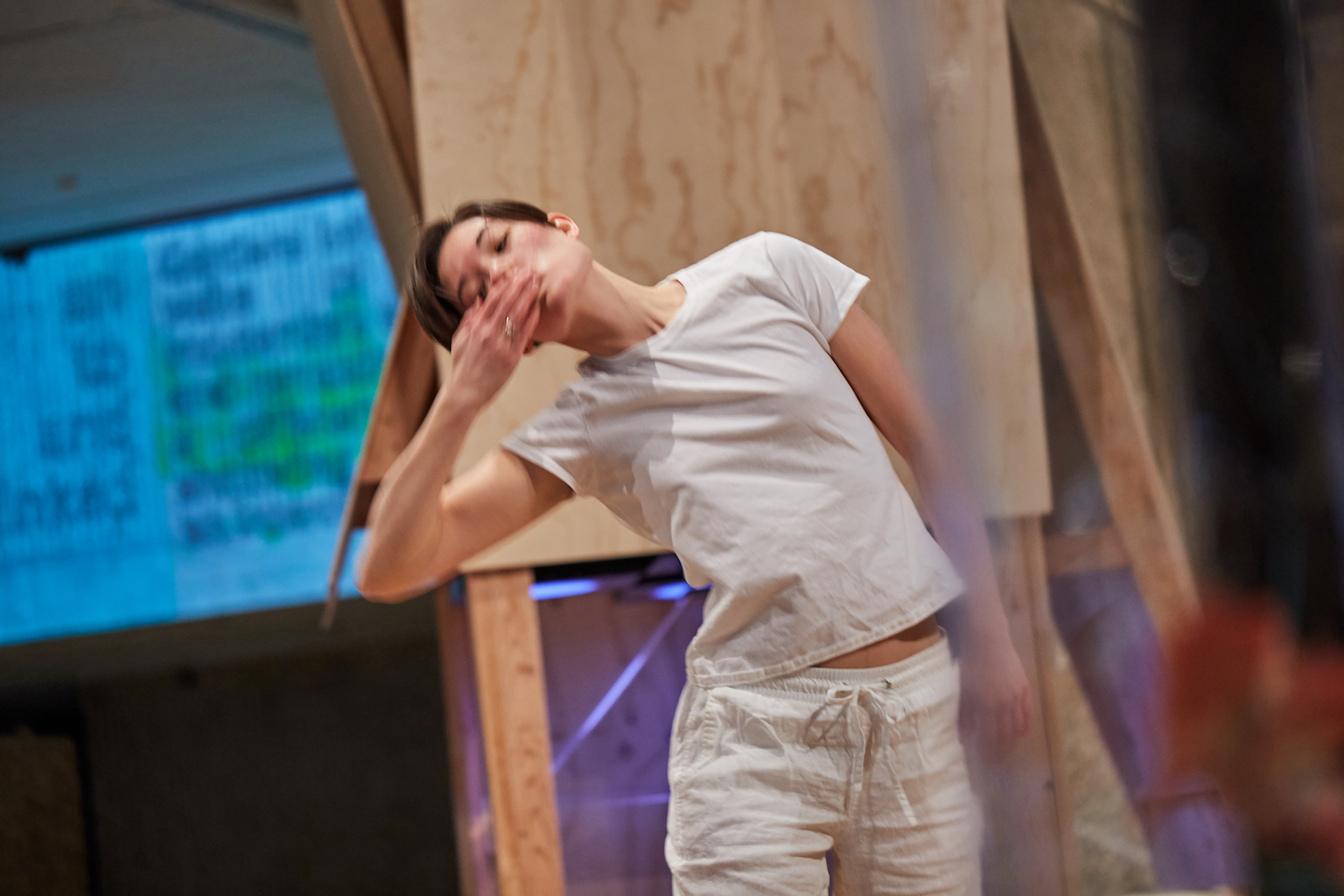
"Theresa, I Miss You" has involved extensive research into theories of diaspora and intergenerational haunting. Since 2018, on the occasion of Cha’s retrospective at the Berkeley Art Museum and Pacific Film Archive (BAMPFA), I have been writing a series of poems each beginning with the line, “Theresa, I miss you.” This line acknowledges the necessarily elegiac nature of a project for Theresa, who was murdered in New York City at age 31, days after Dictée’s publication. It also expresses my personal attachment to Theresa, a figure whose absence echoes my disconnection from Korea and my Korean family. In 2019-2020, I began an improvisational practice in which I "haunted" the Yale campus "as" Theresa. Wearing all white, as Cha did in her performances (white is significant in Korean shamanic traditions), I danced in Yale's plazas, stairwells, and classrooms. I sought to re-program the power-saturated architecture of the academic environment surrounding me, making an intervention which both brought Theresa into the space and allowed me to move differently within it. The affective and formal information discovered during these improvisations was then woven into poems. I gave a first public performance based on that work in early 2020 at the Yale School of Architecture Gallery, titled "Theresa, I Miss You (Rest)." 

I propose to "haunt" NOPF as an iteration of Cha over the course of the festival. I will be present, unspeaking, as Cha, again in all white, moving throughout the different spaces of the festival. During others' performances, I would be present only as observer, but in the interstices, I would use movement improvisation to explore Cha's presence. New Orleans is a powerfully spiritual place, and I have specific personal spiritual history there which draws me to bring Theresa to the city. As context and container for this performance, I would like to take over one of the smaller spaces at New Orleans Healing Center––maybe one of the smaller classrooms, or even a stair landing/other auxiliary space––and create an installation that would become home base for the performance. Ideally, this space would be somewhat enclosed and out of the way, not a hallway or main walkway. I would likely spend much of my time in that space, working with materials or movement. I have a vision for installing the space as an immersive environment, primarily using white fabric, as Cha often did in her works. In 2022, I learned to make bojagi, a traditional Korean patchwork, and I imagine bojagi would figure significantly in the space, both as part of the environment and as one of the things I'd be making over the course of the festival. Rather than any scheduled "performances," the space would be open for people to come and go as they wish.

A woman dancing in a white t-shirt and white pants.
All (Mobile)

Participants